
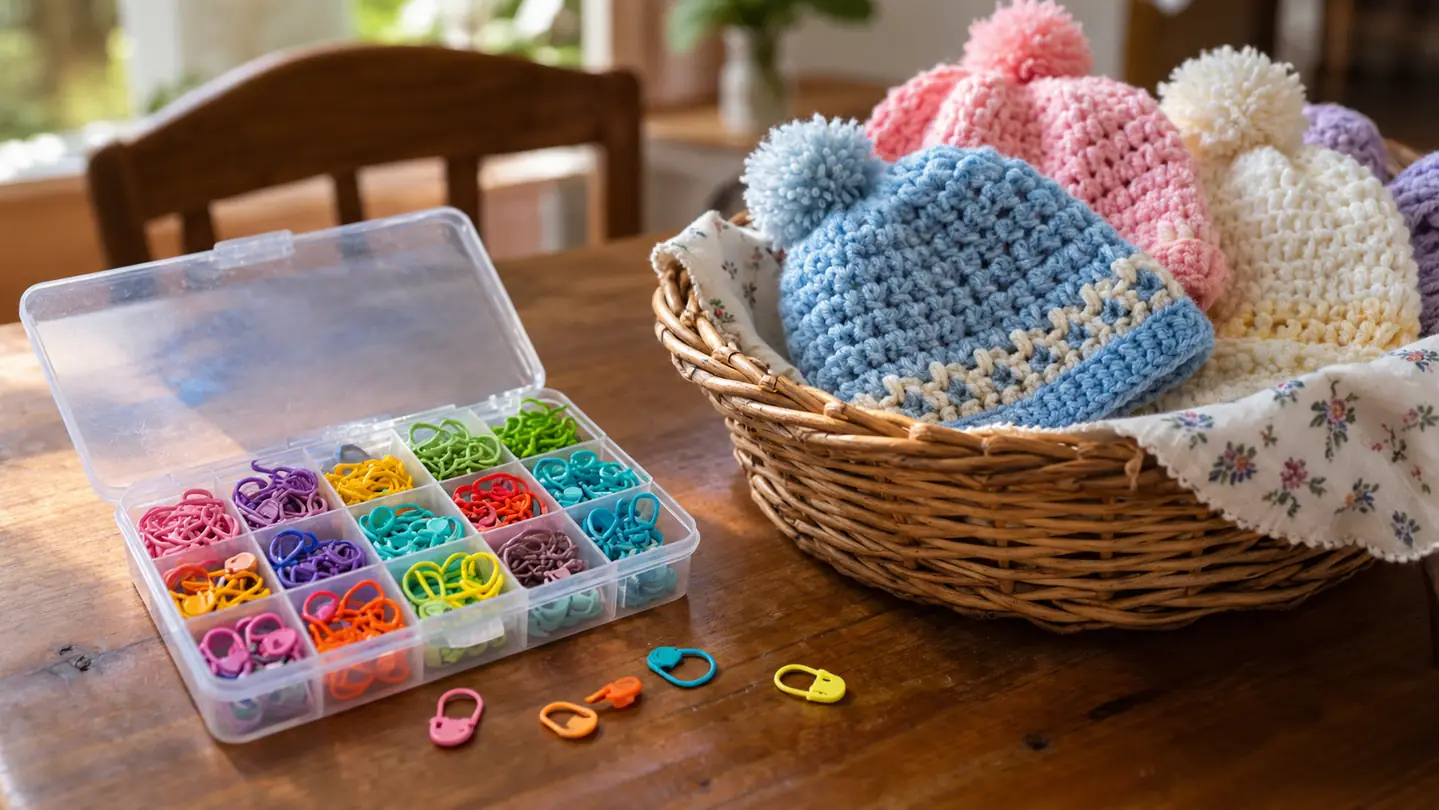
Every fall my church runs a donation drive for the maternity ward, and this year the sign-up sheet asked for sixty baby hats. I taught middle school math for thirty years, so I count the way I do everything else, in a system: six markers per hat, twelve hats per bag, and one small round case of Clover locking stitch markers that ran out of colors by the third hat. So I ordered the Meikeer 150-piece locking stitch marker set with its storage box, half expecting to shelve it after one project. Three months, a dozen blankets, and sixty hats later, both packs live in my house, and the comparison turned out to be less a contest than a division of labor.
The short answer is that neither pack wins outright, and admitting that is the honest part of this review. The Meikeer set gives me 150 markers in 10 colors at a fraction of the per-marker cost of Clover's small sets, and its wider jaw is genuinely easier on my right thumb, which stiffens in cold weather. The Clover markers, for their part, are smoother, snap shut more securely, and have outlasted everything else in my notions bag. I am going to tell you which one goes on the chair arm and which one goes on the kitchen table, because after three months of real use, that answer surprised me as much as anything in this comparison.
Here is the whole comparison in one table. I looked at cost per marker, pack size, color variety, how the clasp feels on stiff fingers, how smooth the plastic runs against fine yarn, and how each pack stores. I marked a tie where the two markers simply do different jobs.
| Meikeer | Clover | |
|---|---|---|
| Per-marker cost | A fraction of the cost in the 150-pack | Sets of 6 to 10 cost several times more per marker |
| Markers per pack | 150 markers in one box | 6 to 10 per set, sold separately |
| Color variety | 10 colors for color-coding rows | 3 to 5 colors in most sets |
| Material feel | Grippy nylon, slight seam lines on some markers | Glass-smooth nylon, no seams at all |
| Clasp security | Snug, but I broke one at the hinge in month two | No slip and no break in the years I have owned mine |
| Opening effort | Wide jaw opens with a light pinch | Tighter hinge needs a firmer squeeze |
| Storage | Three-compartment latch-top box | Small round case, no compartments |
| Spares in person | Order another pack online when you run low | Refill cards at most local yarn shops |
| Best for | Kits, class lots, donation drives with many colors at once | The one or two markers that live on your current project |
Read that table as a division of labor rather than a contest, because that is how it actually behaved in my house. For big jobs, the Meikeer set is the better tool by every measure I care about. For the single marker living on the project in my lap, the Clover set is still the one I reach for. Now let me walk through where each pack wins.
Where Meikeer Wins
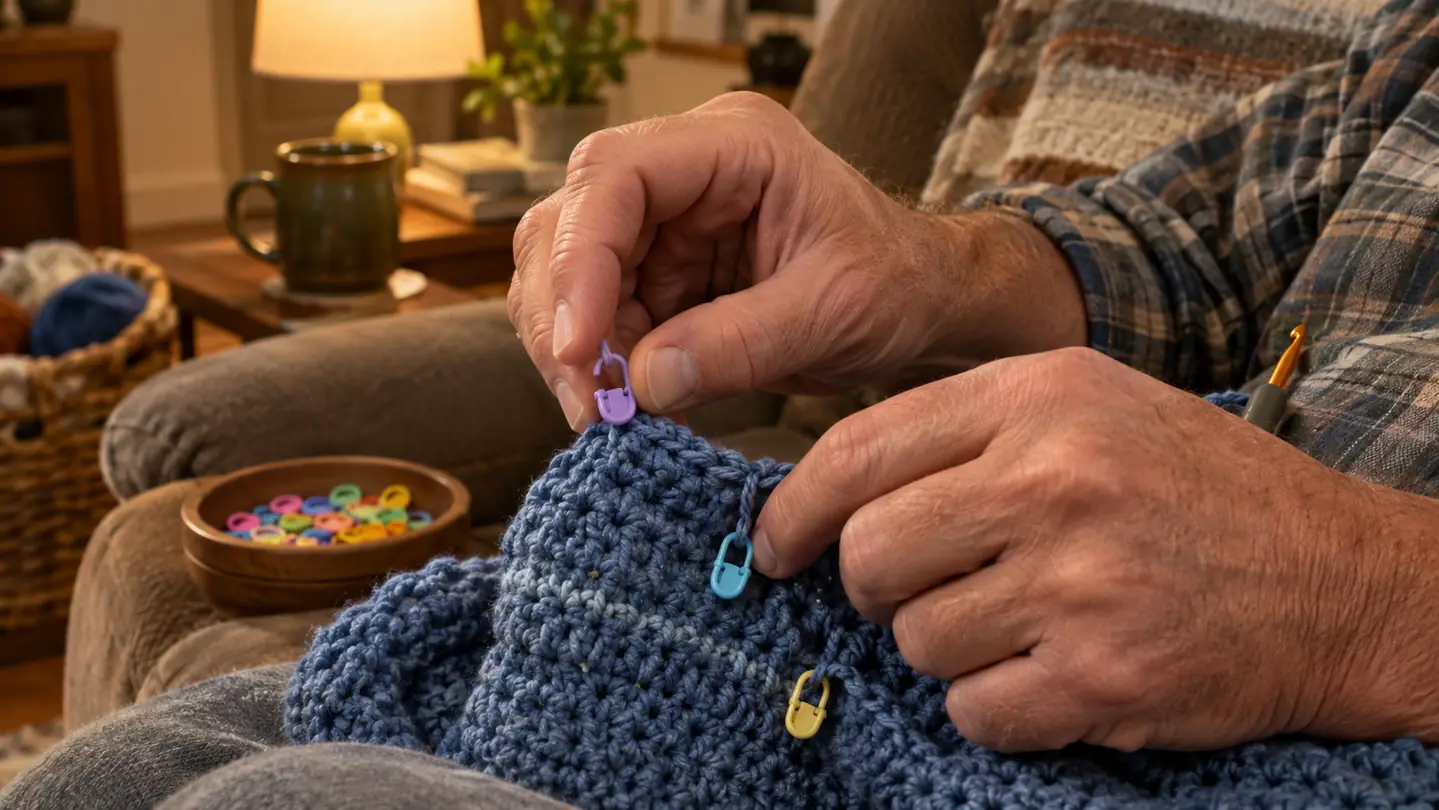
Let me start with the number that matters to a retired math teacher: 150. My Clover case holds about nine markers, and when I sectioned off a baby blanket into its ten-row repeat, I ran out of colors before I ran out of rows. The Meikeer set settles that in one purchase. Ten colors mean I can assign one color to every tenth row, another to every decrease, another to the corner of a dishcloth, and still have spares rattling in the box. For the donation drive I kitted an entire bag of hats at once and never borrowed a marker from another project. That alone earns the box a permanent spot on my kitchen table next to the blocking mats. I still make a swatch for every blanket, and a swatch is a word problem, so the markers do the showing of work for me. I also tested how well the colors read in low light, because my floor lamp in the living room throws a warm glow and some cheaper markers I have tried go muddy under it. The ten Meikeer colors stay distinct, which matters when you are counting ten-row repeats at nine o'clock at night. In thirty years of crochet I have thrown away more marker sets than I can count because the colors blurred together exactly when the count got hard. This set does not do that. And because the pack is so large, I stopped being precious with them. I leave markers clipped into pieces that go into the wash without worrying, and when one wears out, the box still holds 149 friends. That freedom is worth the purchase price on its own. If I were still in the classroom, I would hand a bag of these to every student doing a first swatch and tell them color-coding is just a bar graph you can feel.
The other thing I did not expect is how kind these markers are to my hands. I have mild stiffness in my right thumb joint when the weather turns, and the Clover hinge takes a firm squeeze. By the end of an evening of crochet, that squeeze adds up. The Meikeer jaw opens wider with a lighter pinch, which is the difference between finishing one more row and setting the work down to rest. My husband Glenn noticed the difference before I said a word, because I stopped complaining about my thumb around nine o'clock. I rinsed the whole box under warm water in the sink after a month and the colors did not bleed onto the lighter markers, which surprised me for a budget pack. The storage box earns its place too. Three compartments with a latch keep the ten colors sorted instead of drifting into one pile, and the whole thing sits flat on the kitchen table without rolling. I have knocked it off the table twice now and the latch held both times, which is more than I can say for the round case that used to scatter nine markers across the floorboards. For the cost of one Clover set of six, I got enough markers to treat every project in the house for a year, and the per-marker cost is the lowest I have ever paid for a notion I actually use every single evening.
Here is a real example of how I use the Meikeer markers in bulk. Last October I set up six baby hats at once for the church drive, each one in a different color yarn. Every hat got its own marker color, one in the first stitch of the round and a second color every ten stitches as a checkpoint. When I picked a hat back up two days later, I knew exactly which one it was and where I had stopped, without counting a single stitch. With only a small pack of markers, I could never have kept six projects going side by side like that.
Where Clover Wins
The honest part of this review is where I defend the yarn shop standard. I have bought Clover markers out of a store case for years, and the clasp is the most secure I have ever used, full stop. When a Clover marker snaps shut, it stays shut, through blocking, through a trip through the wash, through being shoved in a project bag and pulled out weeks later. I clipped one of the Meikeer markers too close to its hinge once and the jaw snapped clean in two, which has never happened to a single Clover marker in my stash. The plastic on the Clover markers is also smoother. On a fine baby yarn, the Meikeer seam lines catch a thread now and then, while the Clover bodies glide over the fiber without a whisper. That smoothness matters most on the soft acrylics the donation drive favors, where any little snag can turn into a visible pill in the finished hat. I have also come to appreciate the Clover hinge in a different way, because a marker that needs a firm squeeze is also a marker that never opens by accident when you are pawing through a bag. In a tote with scissors, hooks, and a tape measure jostling around, that extra resistance is a feature, not a bug.
Clover also wins on the small things that keep me loyal. I can walk into any yarn shop in Worcester and buy a refill card of six markers over the counter, no shipping, no waiting, no minimum order. When I need one marker for the hat in my lap, a six-pack is the right unit, not a box of 150. My Clover case lives on the arm of my chair so the current project always has markers within reach, while the Meikeer box lives at the kitchen table for kitting out bigger jobs. That division, a small set for the daily project and a large set for the bulk jobs, turned out to be the whole answer to the question in the headline. I will also say the Clover markers are quieter in a good way. They draw no attention, they just sit in the case looking precise, and after thirty years of crochet I have learned to appreciate tools that look like they mean business. When I hand a finished baby hat to someone at the church, the marker still clipped to its corner is the one I reach for to slide out and pocket, because it is the one I trust not to open on the car ride home.
Clover's markers also open with a softer squeeze, which I noticed on cold mornings when my thumb is stiff. The Meikeer clasps loosen up after a few weeks, but at first they take a firmer press. If your hands hurt every day, that first impression matters, and it is one more reason I keep a few Clover markers in my bag for small projects.
End the marker shortage with one box of 150
The Meikeer locking stitch marker set comes with the storage box, 10 colors, and enough markers for every hat in the donation drive at once. It shares a bag happily with your existing Clover markers, and it will not argue with them.
Amazon Check Today's Price on Amazon →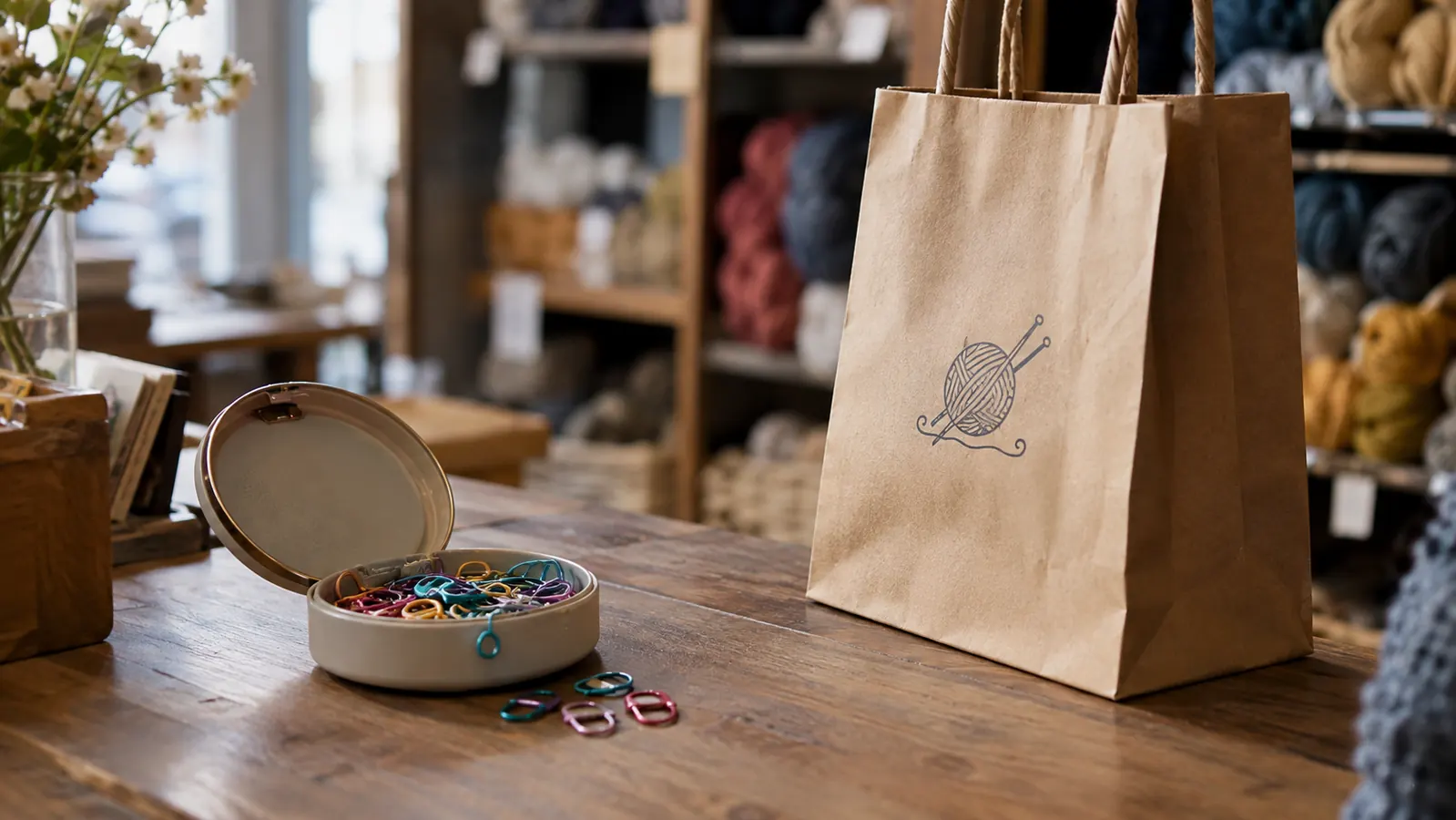
Who Should Buy Which
Buy the Meikeer set if you kit out projects in bulk, if you teach, or if you make gifts for a drive like mine. If you have ever run out of a color mid-repeat, or hesitated to leave a marker in a piece because you could not spare it, the 150-pack removes that hesitation for good. Buy the Clover markers if what you want is one flawless, long-lived set for the project in your lap, and if you like standing at a yarn shop counter on a rainy Saturday picking out a refill card. Most of you will end up with both, the way I did, and that is not a failure of this review. It is the correct outcome, and I would rather tell you the truth than rig the table so one brand wins every row. My rule now is simple: the Clover case stays on the chair arm for daily work, and the Meikeer box stays at the kitchen table for anything that needs more than five markers at once. If I were still standing in front of a classroom, I would say it the same way I used to teach division of labor, use the right tool for the job and the job gets done twice as fast. Three months in, my rows are cleaner, my thumb is happier, and the donation drive has sixty hats with their edges held exactly where they belong.
Stock the box that ends the rationing
One Meikeer 150-piece set with the storage box covers a year of donation drives, class lots, and blankets. If it turns out not to be your thing, it is the easiest marker decision you will make all year.
Amazon See Today's Price on Amazon →