
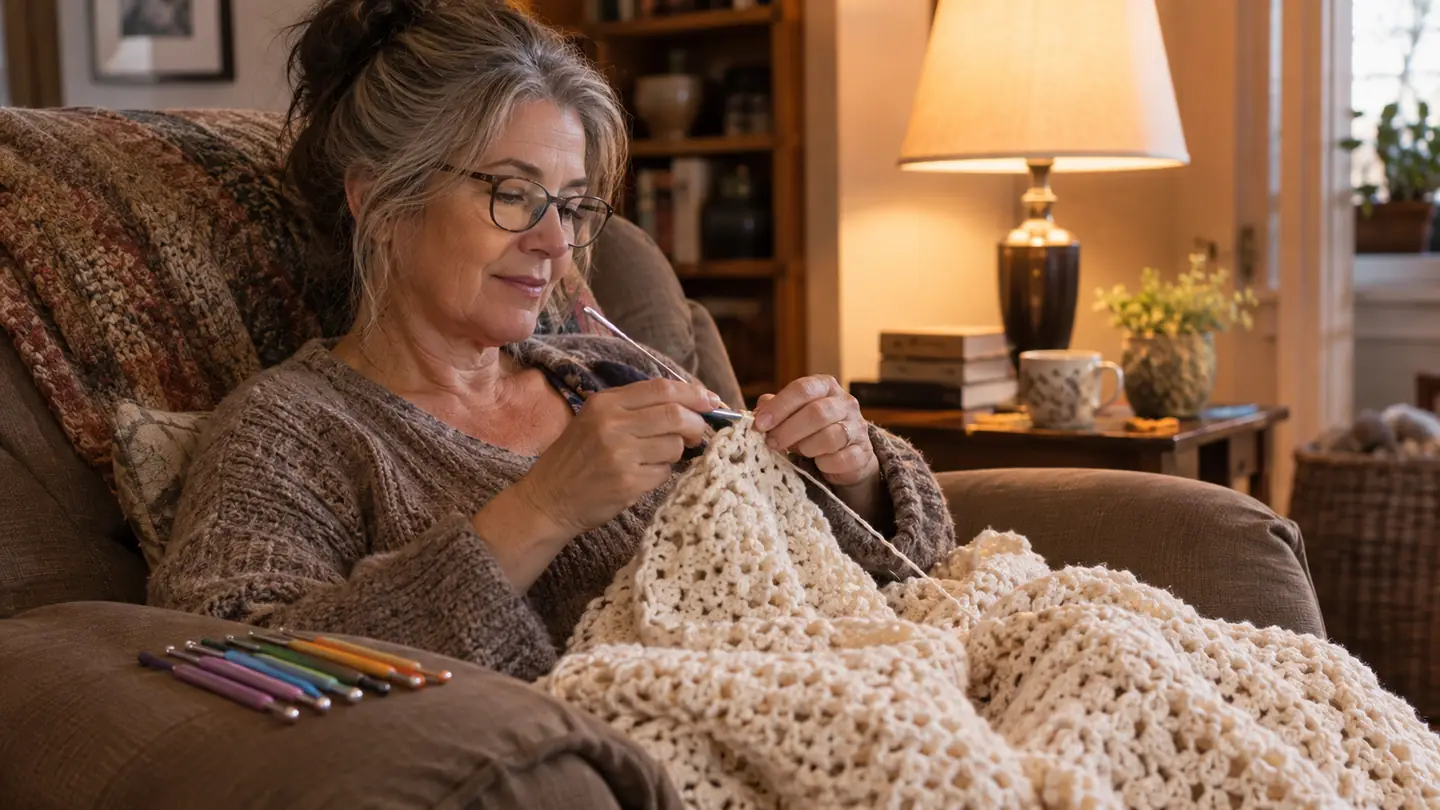
I have a confession to make. I bought the Clover Amour crochet hook set two years ago because my right thumb was sore, and I was tired of being told that the fix was to hold my hook differently. I had been crocheting for nearly 30 years by then, taught by my aunt on a steel hook that would probably count as a weapon now. I did not want a lesson in grip. I wanted a hook that did not make my hand ache by the end of a hat.
So I ordered the Clover Amour set, 10 sizes in a blue case, and I have used it almost daily since. Two years, roughly 40 blankets, more dishcloths than I can count, and a whole shelf of baby hats for the church donation drive. This is the long-term review I kept wishing someone had written before I spent the money.
The Quick Verdict
The Clover Amour set is the rare tool that earns its reputation. The grips are genuinely comfortable, the hooks glide through yarn, and after two years of daily use, nothing has worn out, bent, or let me down. I only wish the case had a few more slots for the odd sizes.
Amazon Check Today's Price →The hook set I reach for every single day
After two years of daily use, the Clover Amour 10-hook set is still the first thing I grab from my bag. If your hands ache after an hour of crochet, this is the upgrade worth trying.
Amazon Check Today's Price on Amazon →How I've Used It
I should be clear about what 'daily use' means in my house. I am a retired middle school math teacher in Worcester, Massachusetts, and I crochet in a recliner in my living room under a floor lamp. Most evenings I put in an hour or two. On weekends, more. My projects are practical: blankets, dishcloths, hats, and baby gifts for my church's donation drive. I am not making fine lace or amigurumi. I am making things that get used and washed.
The set I bought has 10 sizes, from the small steel ones up to the larger aluminum ones, all in a blue fold-out case. I have used every single size at least once, but my daily drivers are the middle sizes, the ones I use for worsted weight yarn. Those hooks have spent more hours in my hand than any other tool I own.
I also have mild stiffness in my right thumb joint in cold weather. That is the real reason I bought these hooks, and it is the lens I use for every opinion in this review. A hook can be beautiful and smooth and still be wrong for me if it makes my thumb worse by February.
To give you a concrete picture, I finished a queen-size blanket in March of last year, roughly 60 inches by 80 inches, worked in half double crochet with worsted weight yarn. I kept a tally in the margin of my pattern book: 214 rows, and I averaged about 9 rows an evening. That is the kind of project that would have had me reaching for a heating pad by week two with my old aluminum hooks. With the Clover Amour, my thumb was stiff on cold mornings, same as always, but it did not get worse as the evening went on. That distinction, not worse, is the honest win.
A normal week looks like this. Monday and Wednesday evenings are for whatever blanket is on the hook, usually two hours each in the recliner after supper. Thursday afternoons I make dishcloths in cotton, which is hard on hands because cotton has no stretch and you have to push the hook through every stitch. Saturday mornings are for small gifts, hats and baby booties for the church drive. That is roughly eight to ten hours a week, and the Clover Amour hooks are in my hand for nearly all of it. When I say these hooks have been tested, that is the testing: ordinary weeks, one after another, with real yarn and a real thumb that complains when it is cold out.
What Makes the Clover Amour Grips Different
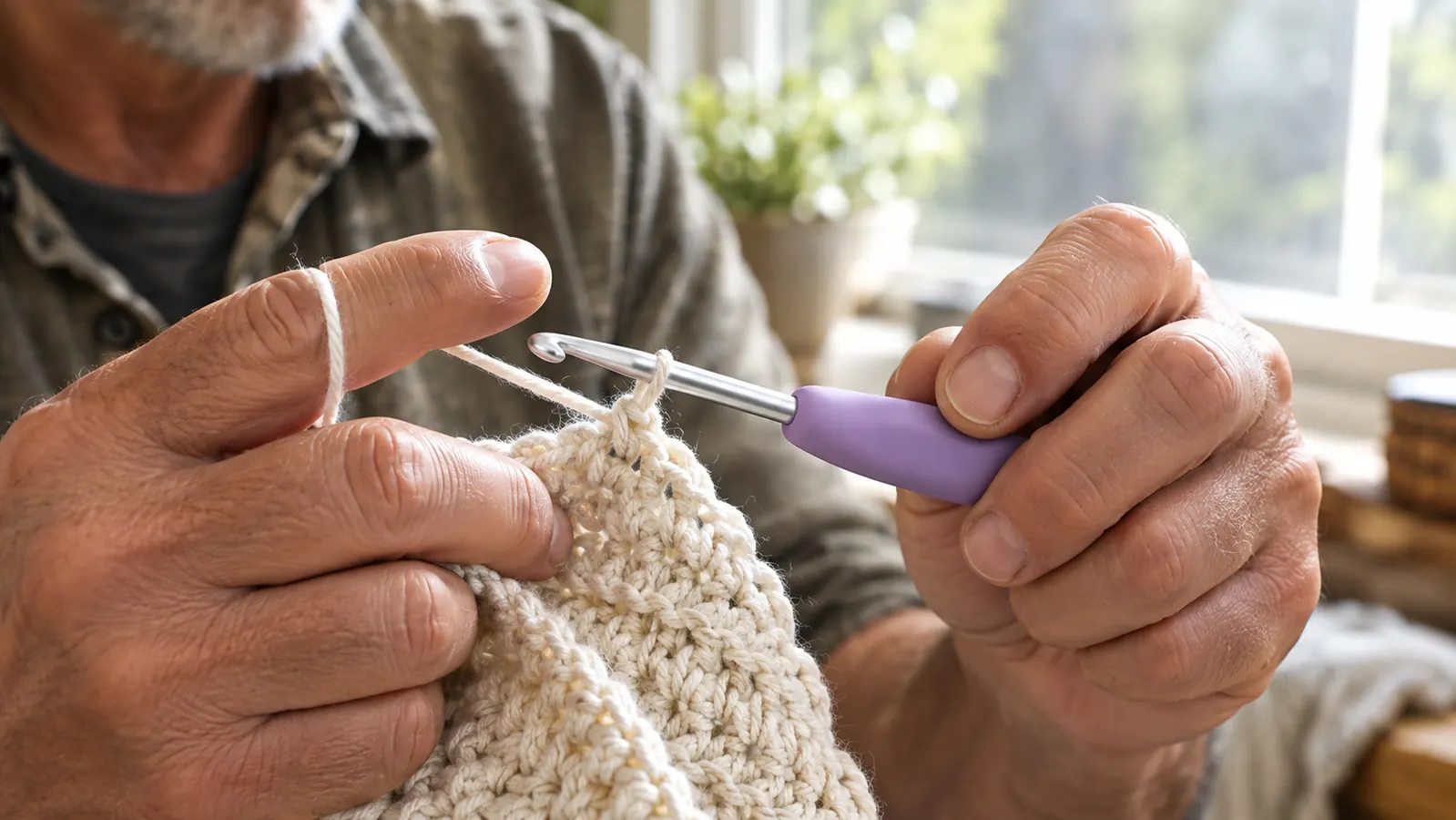
The first thing you notice is the grip. It is a thick, soft, cushioned layer over the handle, and it changes where the pressure lands in your hand. With a plain aluminum hook, I grip tightly to keep it from spinning. With the Clover Amour, I can hold it loosely and it stays put. That sounds like a small thing, but it is the whole ballgame for a sore thumb.
The grip is not just soft, it is shaped. There is a slight contour that fits the pad of my hand, and the hook end has a smooth, rounded throat that lets the yarn slide instead of catching. I have tried hooks where the grip is a separate rubber sleeve that slides around. These are molded on, and after two years, none of mine have moved, peeled, or gotten sticky.
Here is the nerdy part, and I cannot help it, I was a math teacher. The grip reduces the force I need to apply per stitch. When I crochet with a skinny metal hook, I squeeze harder, which fatigues the small muscles in my thumb. With the Clover Amour, the wider grip spreads that force over a larger area, so the pressure per square inch drops. My thumb still gets stiff in cold weather, but it does not get worse from crocheting.
I tested this on purpose last winter. For one week in January, I switched back to my old aluminum hook for a dishcloth, just to see if I was romanticizing the Clover. By the third evening, I was gripping the metal hook hard enough that the side of my index finger had a red line across it. I switched back to the Clover Amour mid-project, finished the dishcloth, and the red line faded over the next day. That little experiment told me the difference is not in my head. It is in the geometry of the handle.
How the Hooks Perform Over Time
After two years, the hooks look almost new. The aluminum shafts are smooth, with no rough spots or burrs. The grips have not discolored or softened. The case still closes flat. I have dropped hooks on tile floors, left them in a project bag for weeks, and washed a blanket that had a hook accidentally folded into it. The hook survived the washing machine. I cannot say the same for my concentration.
The one thing I watch is the hook tip. On cheaper hooks, the tip can develop a tiny burr that snags the yarn. I checked mine under a bright lamp a few weeks ago, and the tips are still smooth. I do not know if that is because Clover uses a better finish or because I am gentle with my tools. Either way, after two years, I have not had a single snag that I could blame on the hook.
The sizes are also accurate, which matters more than most people think. I checked a few of mine against a gauge ruler, and the labeled sizes matched. That means my gauge swatches are reliable, and my blankets come out the size I planned. For a person who treats a swatch like a word problem, that is a quiet kind of joy.
I checked this the way I used to check homework. I crocheted a ten by ten single crochet swatch with the 5 mm hook from the Clover Amour set and the same yarn, then did the same with an older 5 mm hook from another brand. The Clover swatch measured four inches across almost exactly, which matched the gauge on the yarn label. The older hook came out a little wider. That is not a huge difference on a dishcloth, but on a sweater or a fitted hat it adds up fast, and it is the kind of thing you only discover after hours of work.
One small thing I noticed around month 14: the printed size marking on one of my most-used hooks, the one I reach for with worsted weight yarn, had started to look a little faint. I expected it to wear off completely, the way markings do on cheaper hooks. It has not. It is still readable, and I have not had to guess which hook I am holding. That is a minor detail, but it is the kind of detail that tells you how a tool was made.
After two years of daily use, the hooks look almost new, the grips have not moved, and my thumb does not get worse from crocheting. That is the whole review.
What I Wish Were Different
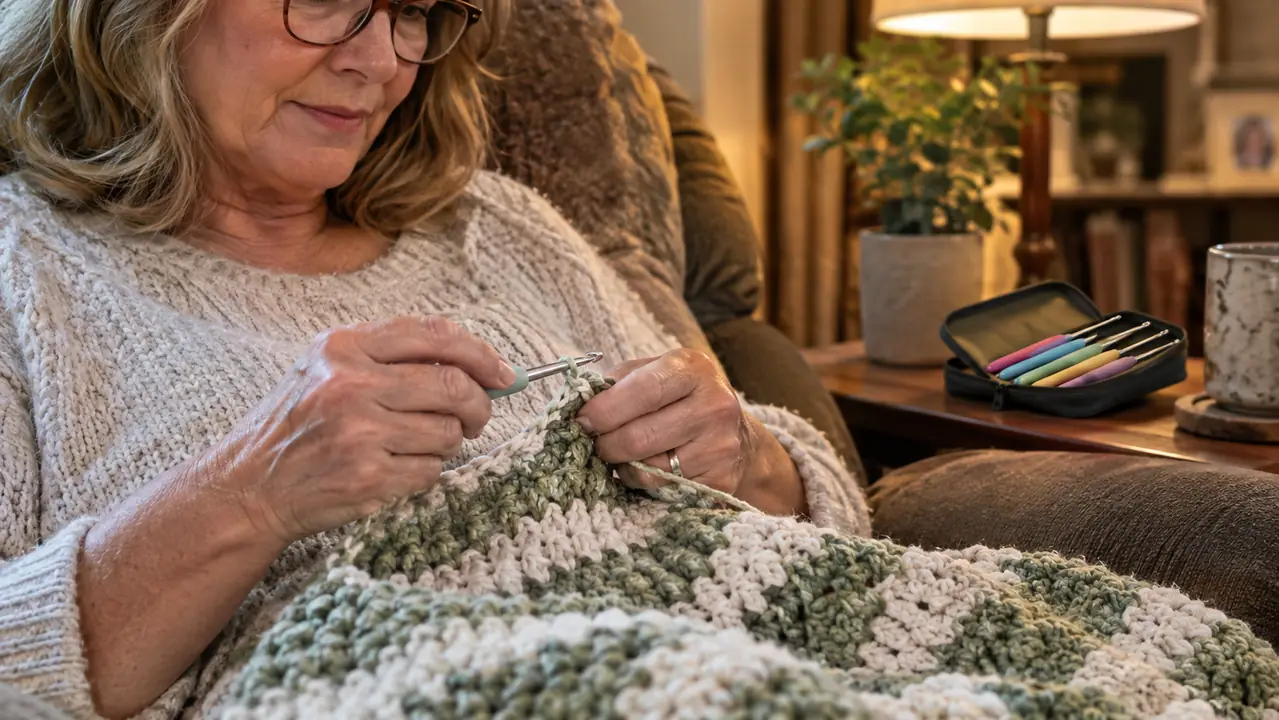
No review is honest without the cons, so here are mine. First, the case. It is a nice blue fold-out case, but it has one slot per hook. If you want to add a hook size that is not in the set, you have to leave it loose in your bag or buy a separate case. I keep a couple of extra hooks in a pencil pouch, which works, but it is not elegant.
Second, the smallest hooks in the set are thin. The grips help, but the steel hooks are still narrow, and for someone with arthritis in their fingers, they might not be enough. I do not use the smallest sizes often, so it does not bother me, but I would not recommend this set to someone who mostly crochets thread doilies.
Third, the price. The Clover Amour set costs more than a basic set of aluminum hooks, and I understand why, the grips are molded on, the finish is better, and the quality has held up for two years. But it is still a real investment, and I would not buy it without checking the current price and reading a few reviews first.
There is one more thing I will mention, and it is small. The case does not have a clasp or a zipper. It folds shut and tucks closed, and it stays closed in my project bag, but if you toss your bag around the way I do, the case can pop open. I have had hooks slide out twice. Nothing got lost, but it is worth knowing if you plan to travel with the set.
What I Liked
- Grips are molded on and have not moved, peeled, or gotten sticky after two years of daily use
- Hooks glide through yarn with a smooth throat that rarely snags
- Sizes are accurate, so gauge swatches and finished measurements come out right
- The set covers 10 sizes, from small steel hooks up to larger aluminum ones
- Tips have stayed smooth with no burrs after heavy use
Where It Falls Short
- The case has one slot per hook, with no room for extra sizes
- The smallest hooks are still thin and may not help hands with arthritis
- The case has no clasp and can pop open in a bag
- Costs more than a basic set of aluminum hooks
Who This Is For
Buy the Clover Amour set if you crochet for more than an hour at a time and your hands have started to complain. Buy it if you are tired of hooks that spin in your grip or snag your yarn. Buy it if you want one set of hooks that will last through years of blankets, hats, and dishcloths without wearing out. And buy it if you, like me, would rather spend your energy on the stitches than on squeezing a skinny piece of metal.
I would also point someone toward this set if they are just starting out and learning on a hook that fights them. A beginner does not need to learn that crochet hurts. They need a hook that lets them focus on tension and stitch shape. The Clover Amour set is more than a beginner needs, but it is the kind of tool that keeps a beginner from quitting in frustration.
Who Should Skip It
Skip it if you only crochet occasionally, a few times a year, because a cheaper set will do the job. Skip it if you mostly work with thread and tiny hooks, because the smallest sizes here are still thin. And skip it if you are hoping a hook will cure arthritis or eliminate hand pain entirely. It will not. It will make crocheting more comfortable, but it is a tool, not a treatment.
I will also say this plainly: if you are happy with the hooks you already own, you do not need these. The Clover Amour set is a comfort upgrade, not a magic fix. My old hooks still work. I just do not reach for them anymore, because my thumb knows the difference.
Two years in, I would buy them again
The Clover Amour set has earned its place in my bag. If your hands ache after an hour of crochet, this is the upgrade I would make first.
Amazon Check Today's Price on Amazon →