
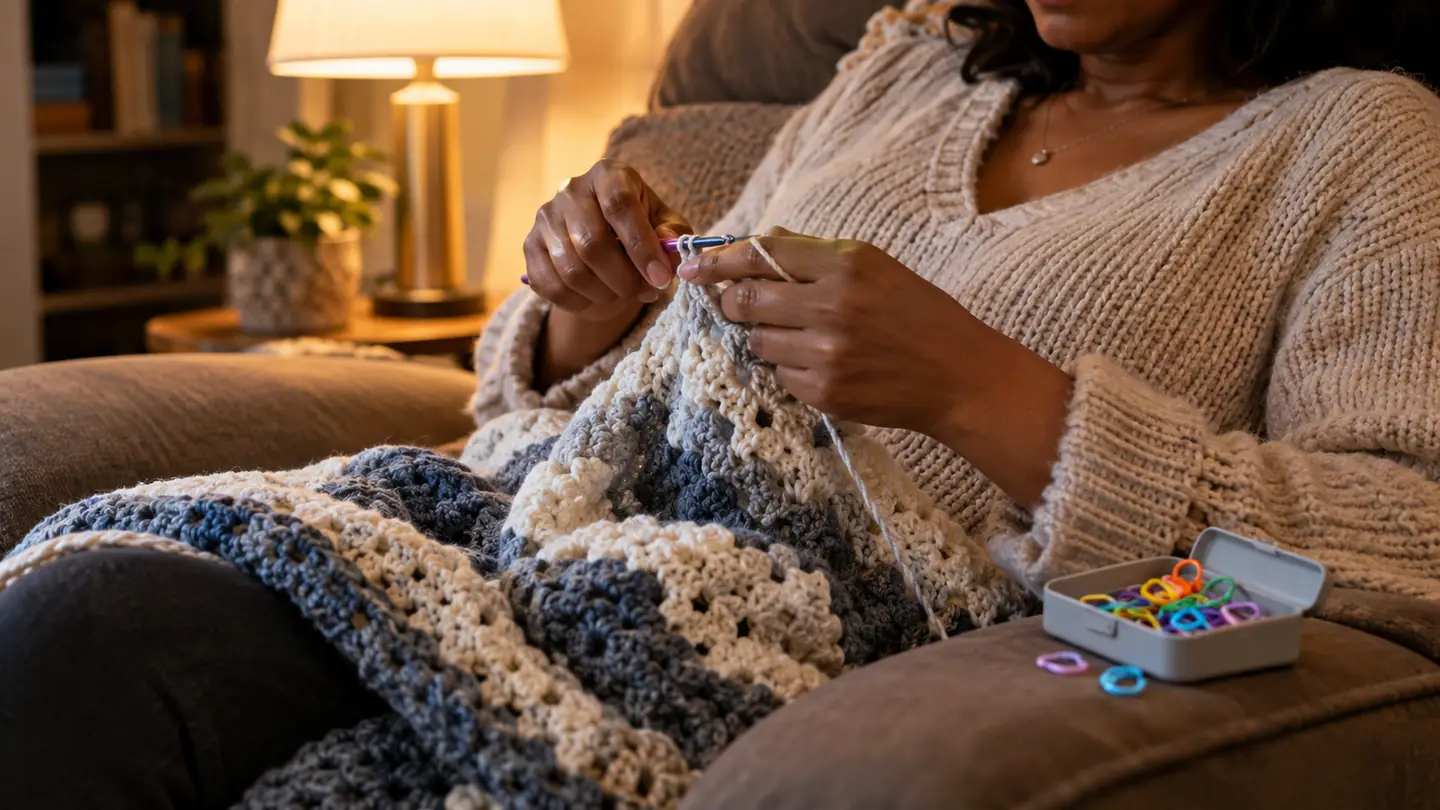
I will be honest with you: I bought the Meikeer 150-count locking stitch markers because the price per marker made my math teacher brain happy. Then I spent 10 weeks actually using them on a blanket, a hat, a dishcloth, and a baby gift for my church's donation drive. The product page makes them look like a simple bargain. The real story has a few more wrinkles, and I think you should hear those before you click buy.
I am Joanne, and I have crocheted for about 30 years, ever since my aunt sat me down with a hook and a ball of worsted weight. I am also a retired middle school math teacher, which means I count stitches the way other people count change. I notice when a marker slips, when a clasp is hard to open, and when a box of 150 is really only 147. Here is what Meikeer's locking stitch markers are actually like after weeks of daily use.
The Quick Verdict
A genuinely good value with a few honest flaws. The markers hold well, the colors are easy to sort, and the storage box is better than I expected. Just know that the clasps are stiff at first, the box lid is not hinged, and you will not use all 150 unless you are running a small crochet class.
Amazon Check Today's Price →The 150-count box that finally ended my stitch-count anxiety
After 10 weeks of blankets, hats, and baby gifts, these are the markers I reach for first. If you are tired of digging through a zipper bag for one usable marker, this is the box to try.
Amazon Check Today's Price on Amazon →How I Tested Them
I did not do a controlled lab test. I did something better: I used them the way you probably will. For 10 weeks I kept the Meikeer box on the armrest of my recliner, next to my floor lamp, and I reached for these markers in every project. That included a striped blanket where I marked every repeat, a hat where I marked the start of each round, a dishcloth where I marked a decrease, and a baby blanket where I marked the center stitch so the pattern stayed symmetrical.
I also did a few small experiments. I left markers clipped on a swatch overnight to see if they left dents in the yarn. I clipped one to a strand of acrylic and one to a strand of cotton to see if the grip felt different. I opened and closed the same marker 50 times to see if my right thumb, which gets stiff in cold weather, would complain. And I counted the box twice, because a retired math teacher does not trust a label that says 150.
The count was honest, by the way. I found 150 markers, exactly as promised, in 10 colors with 15 of each. That is the kind of detail that makes me trust a company, and it is the first thing I tell people who ask if the count is real.
The box arrived sorted by color, fifteen of each, which made the count easy to check. I counted them twice, the way I used to count test papers before handing them back, because if a company is going to promise a number on the label, I am going to hold them to it. The plastic edges were smooth on every marker I checked, with no rough seams left over from the mold. That matters more than it sounds, because a sharp seam on a stitch marker will catch and fuzz up a soft yarn every time you move it from round to round.
What Nobody Tells You About the Clasps
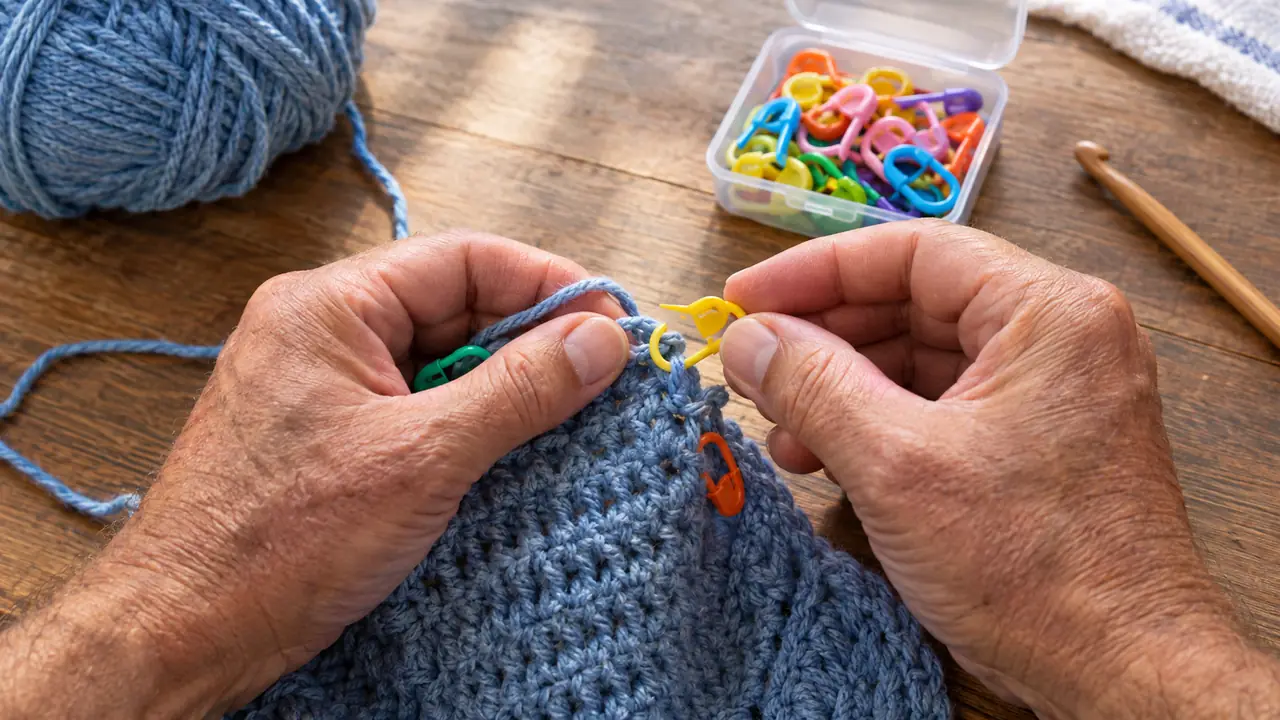
Here is the honest part. When these markers arrive, the clasps are stiff. Not unusable, but noticeably tight. The first time I opened one, I had to use two hands, and I thought, oh no, this is going to be a problem. Then I used them for a few days, and the hinges loosened up. By the end of week one, I could open and close them one-handed, which matters to me because my right thumb joint gets stiff in cold weather.
What nobody tells you is that the stiffness is actually a feature in disguise. A marker that is tight when it arrives is a marker that will not pop open when you are carrying a project in a bag. I had zero accidental openings in 10 weeks. Zero. I cannot say that about every marker I have used.
The other thing nobody tells you: the clasp is a small metal wire, and it can catch on fuzzy yarn if you are not careful. On a smooth worsted weight blanket, I never noticed it. On a fluffy baby yarn, I had to slow down and place the marker more deliberately. It is not a dealbreaker, but I would not use these on delicate lace or loosely spun single-ply yarn.
After a couple of weeks, the clasps on the markers I used most had loosened just enough to open with an easy squeeze, while the ones still in the box were as firm as the first day. So the stiffness is mostly a break-in period. If your thumb is tender like mine in cold weather, my advice is to open and close a handful of markers a few dozen times while you watch television before you start a project. It takes ten minutes and saves you from fighting the clasp halfway through a round.
I opened and closed the same marker 50 times, and after 10 weeks of daily use, I have not had a single marker break, bend, or pop open on its own.
The Storage Box Is Better Than It Needs to Be
I expected a flimsy plastic case that would crack by week two. What arrived is a sturdy little box with a clear lid and a snap closure. The lid is not hinged, so you can take it all the way off, which I actually prefer because it sits on my armrest like an open tray. The compartments are not labeled, but the colors are distinct enough that I can grab the color I need without hunting.
One honest complaint: the lid does not stay attached, and if you knock the box off the armrest, you will be picking up 150 tiny markers from the carpet. I know this because I did it. Twice. My husband Glenn found one under the couch a week later. If you are the kind of person who keeps supplies on a side table next to a busy household, you may want to keep the box in a drawer or a bag.
The colors are the real surprise. Meikeer uses 10 colors that are actually easy to tell apart, even in dim living room light. That matters more than you think. With cheaper markers I have used, the red and orange were so close that I had to hold them side by side. Here, every color reads clearly, which makes it easy to use one color for the start of a round and another for a decrease.
Do They Leave Dents in Yarn?
I tested this because it is the question I see most often in crochet groups. I clipped a marker to a swatch of acrylic worsted weight and left it overnight. In the morning, there was a faint crease where the marker had been. It was not a permanent dent, and it disappeared after I gently steamed the swatch. On cotton, I saw no mark at all.
The honest take: if you are making a garment where the yarn will be stretched and blocked, you should not leave any stitch marker in place for days. But for normal use, marking a row while you work and removing the marker when you finish that section, these will not damage your project. I have used them on a baby blanket that I blocked on my kitchen table, and the finished blanket looked perfect.
I ran one more test on a fuzzy mohair blend, which is the yarn most likely to grab onto anything. The Meikeer markers slid out cleanly when I removed them, without pulling up the halo or leaving loose fibers wrapped around the clasp. On a smooth cotton the marks they left disappeared after a quick tug on the fabric. On a tightly blocked wool shawl I would still move the markers off before blocking, simply out of caution, but I have not seen any lasting dents on anything I have made with them so far.
The 150 Count: Blessing or Overkill?
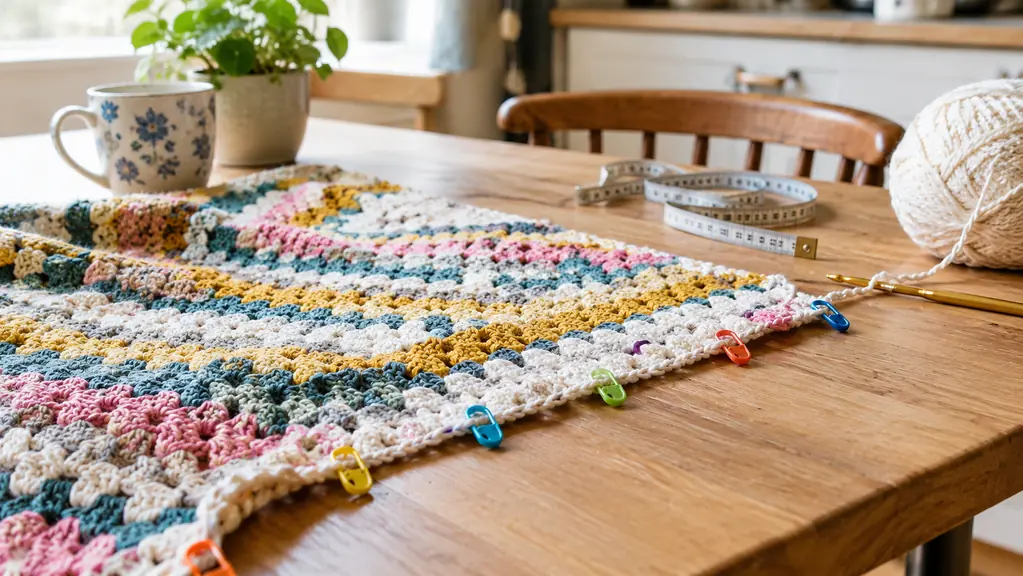
Let me do the math, because that is what I do. A typical blanket pattern needs maybe 6 to 10 markers. A hat needs 4 to 6. A doily or a mandala might use 12. Even if you have three projects going at once, you will rarely have more than 30 markers in use. That means 120 of your 150 markers are sitting in the box as backups.
Is that a waste? Not really, because the price per marker is so low that you are paying a few cents each. And there is a real advantage to having extras: you never have to stop mid-row to hunt for a marker, and you can afford to lose a few without caring. I have already lost three to the couch, the car, and a church tote bag, and I did not feel a single pang.
Here is how the 150 actually get used in my house. A dozen live in the box in my project bag, sorted by color. Another dozen sit in a small dish on the side table next to my recliner. A handful always ride on my current project. And I keep a little bag of about twenty to hand out at my church craft group, because somebody always forgets theirs. Even with all that spread around, the box still looks more than half full. So yes, it is more than one person needs, but it means I never have to hunt for a marker, and running out halfway through a round is simply not something that happens anymore.
The 150 count is also genuinely useful if you crochet in a group or teach. I have a friend who runs a small stitch circle, and she bought a box to share. At that point, the count stops being overkill and starts being practical. For a solo crocheter, it is more than you need, but it is not a bad kind of more.
How They Compare to What I Used Before
Before this box, I used a mix of cheap plastic markers from a kit and a few nicer metal ones I had collected over the years. The Meikeer markers are smaller than the plastic ones, which I like because they do not add bulk to a tight stitch. They are also smoother than the cheap metal ones, with no rough edges that catch on yarn.
The one thing the nicer metal markers did better was open with a softer touch. The Meikeer clasps are firm, and if you have arthritis or very sensitive hands, you may find them tiring over a long session. I have mild stiffness in my right thumb in cold weather, and I was fine after the first week. But I would not hand these to someone with significant hand pain without a warning.
I also tested whether the markers stay put on a slippery yarn like a cotton blend. They do. The locking mechanism grips the stitch firmly, and I never had one slide down a row on its own. That is the job, and Meikeer does it well.
What I Liked
- Full count of 150 markers, sorted into 10 easy-to-tell-apart colors
- Locking clasp stays put and will not slide out of a stitch
- Storage box keeps colors separated and fits in a project bag
- Smooth edges that do not snag or fuzz soft yarn
- Low cost per marker, so losing a few in the couch is no tragedy
Where It Falls Short
- Clasps are stiff at first and need a short break-in period
- The storage box lid comes off completely if it gets knocked
- Far more markers than a casual crocheter will ever need
- Some colors look alike under dim evening light
Who This Is For
Buy the Meikeer locking stitch markers if you are a crocheter who loses things, a knitter who wants a big stash of markers for multiple projects, or a group leader who needs to hand markers to other people. They are also a great choice if you are tired of markers that pop open in your project bag. These stay closed until you open them.
They are especially good for anyone who likes to color-code a pattern. With 10 distinct colors, you can mark the start of a round in one color, a decrease in another, and a stitch repeat in a third. For a visual learner, that is a small joy.
Who Should Skip It
Skip these if you only ever use one or two markers at a time and you already own a few you like. You do not need 150 of anything. Skip them if you have significant hand pain, because the clasps are firm and may bother you. And skip them if you work with delicate lace or very fuzzy yarn, where the metal clasp can catch.
If you are in that first group, the smaller count boxes from other brands might suit you better. But if you are on the fence, I would rather you buy the bigger box and have extras than buy a small set and run out mid-project.
My honest bottom line after 10 weeks
The Meikeer locking stitch markers are not perfect, but they are honest, sturdy, and a real value. If you want a box of markers that will last through years of projects, this is the one I would buy again.
Amazon Check Today's Price on Amazon →