
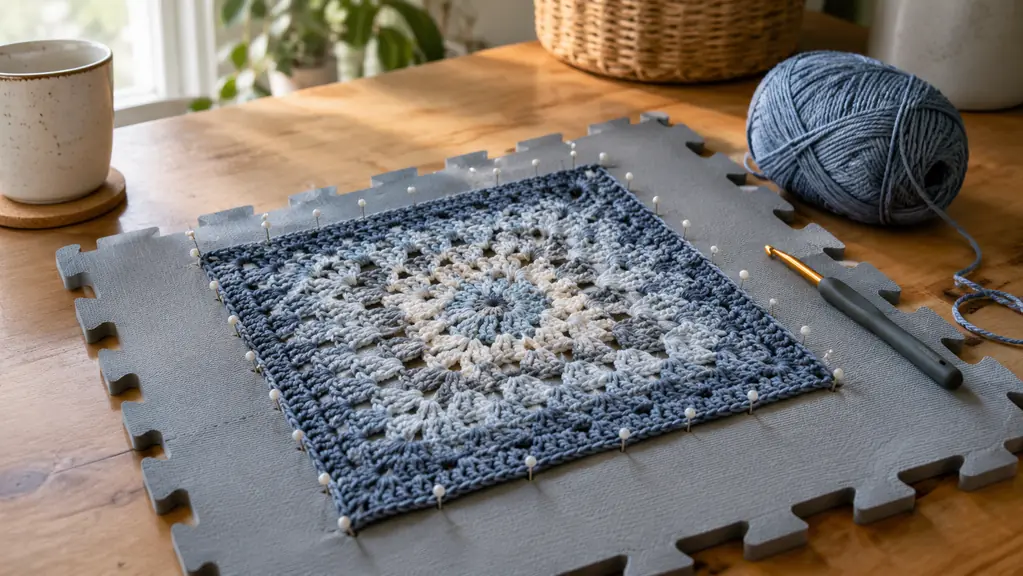
I have been crocheting for about 30 years, and for most of that time I blocked the way my aunt taught me: damp dish towel, iron on low, prayer. It worked, sort of. Then I retired from teaching middle school math, and suddenly I had time to make things that actually needed to look good, not just hold together. So I bought the KnitIQ blocking mats, the standard 9-piece set, and I have strong opinions about them now.
This is the honest review I wish someone had written before I ordered. Not the five-star listing summary. The parts about thickness, pins, and price that nobody tells you. I bought them with my own money, used them on real projects for church donations and gifts, and kept notes the whole time, so this review leans on those notes rather than on first impressions.
The Quick Verdict
The KnitIQ mats are the best value in blocking mats I have used in 30 years of crochet, as long as you know what you are getting: firm but not rock-hard foam, pins that do the job, and a price that beats the big names.
Amazon Check Today's Price →The blocking mats I reach for every single time
After months of using the KnitIQ 9-piece set on everything from baby blankets to dishcloths, I keep coming back to these mats. They pin well, they hold their shape, and they store flat.
Amazon Check Today's Price on Amazon →How I've Used Them
I block at my kitchen table, the same one where I grade papers for the occasional tutoring gig. The table is about 30 inches by 60 inches, and the 9-piece KnitIQ set covers most of it when I lay the mats out in a three by three grid. Each mat is roughly 14 inches square, so I get a blocking surface of about 42 by 42 inches. That handles a baby blanket in sections, a stack of dishcloths, or a dozen granny squares at once.
My usual projects are blankets, dishcloths, hats, and baby gifts for my church's donation drive. I have blocked all of them on these mats. I have also done the thing the instructions tell you not to do: I left a piece pinned overnight. The mats survived. The piece came out perfectly flat.
The one thing I have not done is steam blocking directly on the mats. I use a handheld steamer held a few inches above the surface, and I have never had a problem. I would not press a hot iron directly on the foam, because that is how you get a melted mat and a ruined project.
To give you a fair picture, here is what has gone across these mats. Baby blankets made of joined squares, a lace shawl in a fingering weight wool, a stack of cotton dishcloths, several hats that I blocked over a balloon and then flattened on the mats to set the brim, and a cardigan in pieces before seaming. Some of those were wet blocked, some were spray blocked, and the shawl was pinned hard and left for two days. That mix covers most of what a home crocheter will ever ask a set of blocking mats to do.
What the Listing Photos Don't Show You
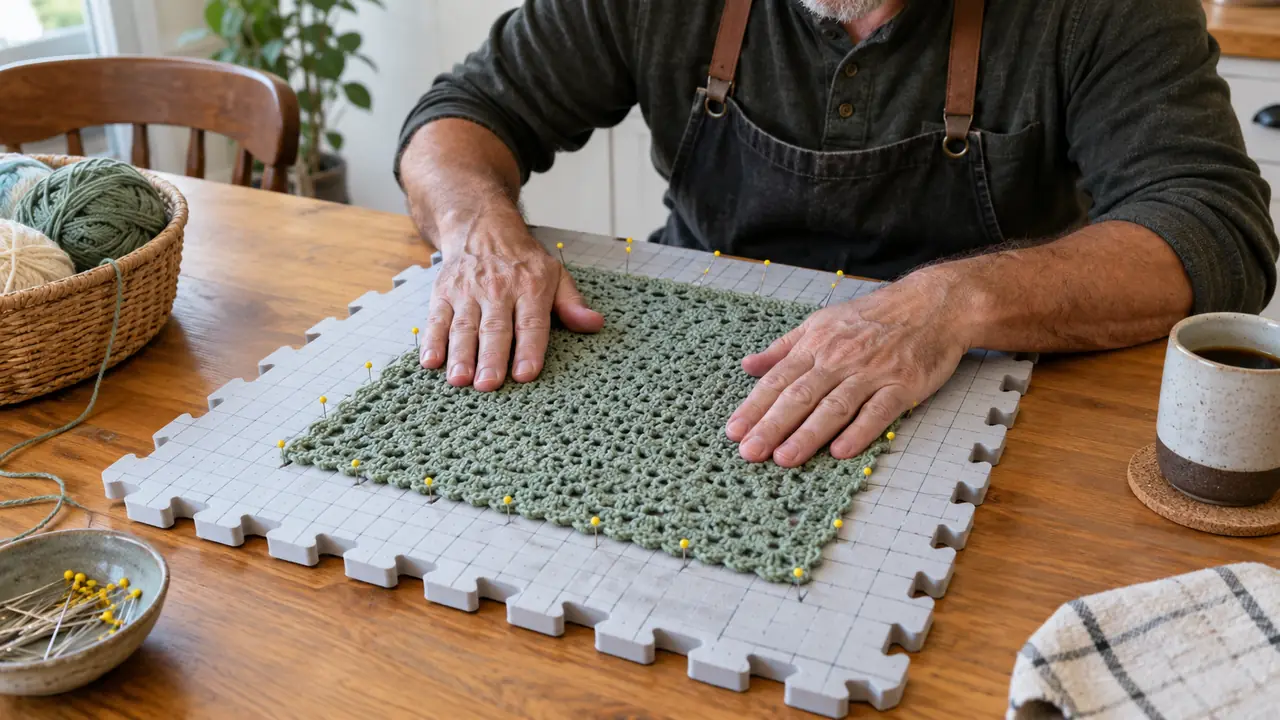
The listing photos make the KnitIQ mats look like a flat, uniform grid of gray foam. They are not wrong, exactly, but they do not show you the texture. The surface has a subtle waffle pattern, a grid of small squares that you can feel when you run your hand across it. That texture is actually useful: it gives the yarn something to grip, so your pieces do not slide around while you are pinning them.
Another thing the photos cannot show is the smell when you first open the package. There was a mild foam odor, like a new yoga mat, that faded after I left the mats spread out in the spare room for a couple of days. It never transferred to any yarn. I mention it only so you are not surprised, and so you give them a day or two to air out before you block something precious.
What the photos also do not show is how the mats feel when you press a pin into them. The foam is firm, much firmer than the cheap interlocking floor mats you can buy at a big box store. It takes a little pressure to push a pin in, but not so much that your thumb aches. For me, that matters. I have mild stiffness in my right thumb joint in cold weather, and I have used blocking mats that felt like pushing pins into a brick. The KnitIQ mats are not like that.
The photos also do not tell you that the mats have a slight give when you press down on them. That is a good thing. It means the pins hold firmly, but you can still adjust a corner without wrestling the pin out.
Thickness: The Number That Actually Matters
Here is the math teacher in me coming out. The thickness of a blocking mat matters more than most crocheters realize. A thin mat, under half an inch, lets the pins tilt and the yarn slip. A thick mat, over an inch, is hard to store and hard to pin. The KnitIQ mats sit in the sweet spot. They are about half an inch thick, which is enough to hold a pin firmly and enough to keep the mat from curling at the edges.
I measured them, because of course I did. The thickness is consistent across all nine mats, which is not something I can say for every set I have tried. I have owned blocking mats where one tile was noticeably thinner than the others, and that thin tile became the weak spot where pins would not stay. The KnitIQ mats are uniform, and that uniformity is what makes them reliable.
The thickness also affects how the mats lie on the table. Thin mats develop a curl at the edges after a few uses, especially if you store them rolled up. The KnitIQ mats have stayed flat on my kitchen table for months. I store them flat under my bed, which helps, but the firmness of the foam is doing most of the work.
There is a practical reason the thickness matters to me in particular. My right thumb gets stiff in cold weather, and pushing pins into a thin, dense board takes real pressure. On the KnitIQ mats a T-pin goes in with an easy push, almost like pressing into a firm cushion, and it comes out the same way. Over a session where I place eighty or a hundred pins, that difference decides whether my hand is tired or fine by the end.
Pins: The Part Everybody Forgets
Every blocking mat review talks about the mats. Almost nobody talks about the pins, and the pins are half the battle. The KnitIQ set does not come with pins, which is the first thing that surprised me. I already had a collection of T-pins from years of quilting, so I was fine. But if you are new to blocking, you need to budget for pins separately.
The good news is that the KnitIQ mats work with any standard T-pin. I have used cheap steel pins and expensive coated pins, and both hold fine. The firm foam grips the pin shaft, so the pin does not wobble or lean. That is the test of a good blocking mat: not how it looks, but whether a pin stays where you put it.
My own pin habit is simple. I use stainless steel T-pins, because they do not rust when they sit in a damp shawl overnight, and I keep them in a small jar with a magnet lid so they cannot spill. For lace I also use blocking wires through the edges, which saves dozens of pins and gives straighter lines. The mats hold the wires as well as they hold pins.
One thing I will tell you that nobody mentions: the mats are slightly tacky on the surface, so pins go in with a little resistance. That resistance is what holds the yarn in place. If you are used to mats that feel like butter, the KnitIQ mats will feel different at first. Give it a week. You will prefer the grip.
The test of a good blocking mat is not how it looks. It is whether a pin stays where you put it, and the KnitIQ mats pass that test every single time.
Price: The Honest Math
I am not going to tell you the exact price, because prices change and I do not want you making a decision on stale numbers. What I will tell you is that the KnitIQ 9-piece set costs less than the big-name blocking mats, and it performs just as well for most projects. I have used mats that cost three times as much, and the difference in results was not three times better.
Here is the math I actually did before buying. A 9-piece set gives you 9 mats at roughly 14 inches square each. That is about 1,764 square inches of blocking surface. For the price, that is a lot of surface per dollar. The big-name sets often give you fewer mats or smaller mats for a higher price. The KnitIQ set is the value pick, and I do not say that lightly.
The other price consideration is durability. A cheap set that falls apart after six months is not a bargain. I have had my KnitIQ mats for long enough to know they hold up. The edges have not frayed, the surface has not peeled, and the interlocking tabs still fit together snugly. That is the kind of durability that makes a price worth it.
There is one more way to think about value. A blocked project looks finished, and an unblocked one often looks homemade in the wrong way. If you give crochet as gifts, or donate it like I do, the mats are the step that makes the work look the way you meant it to. I have had more compliments on the fit and drape of my gifts since I started blocking properly than in the twenty years before, and I do not think that is a coincidence.
What Nobody Tells You About Interlocking Tabs
The KnitIQ mats connect with interlocking tabs, like puzzle pieces. That is a feature, but it is also a quirk. The tabs are sturdy, which is good. They click together firmly, and they stay together while you are pinning. But they also mean the mats are not perfectly flush at the seams. There is a tiny ridge where two mats meet, and if you are blocking a large piece that spans the seam, you will feel that ridge under your yarn.
Is that a dealbreaker? No. The ridge is small, and it does not affect the final shape of your piece. But it is the kind of thing nobody puts in the listing, and I think you should know it before you buy.
The tabs also mean you need to be careful when you take the mats apart. If you pull too hard, you can bend a tab. I have not broken one yet, but I have learned to separate the mats by pushing the seam apart rather than yanking. Treat them gently and they will last.
What I Liked
- Thick enough to hold T-pins firmly without much push from tired hands
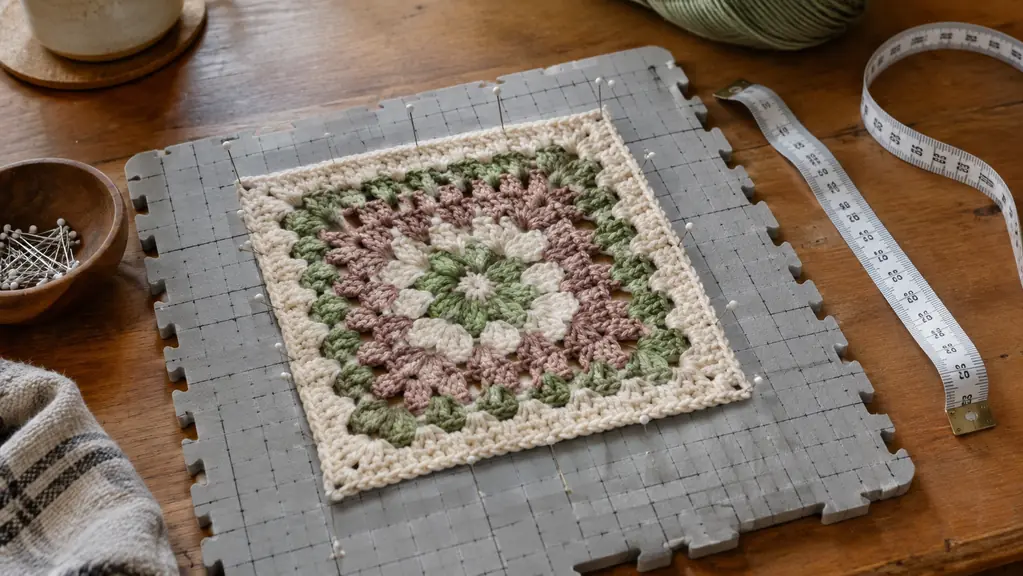
- Printed grid makes squaring up and measuring easy
- Nine interlocking pieces can be arranged for small or large projects
- Holds up to wet blocking and long pinning sessions without warping
- Comes apart and stacks flat for storage between projects
Where It Falls Short
- Interlocking tabs leave a small ridge where the mats join
- Not meant for a hot iron set directly on the surface
- Pins are not included and have to be bought separately
- The full layout takes a lot of table space
Who This Is For
The KnitIQ blocking mats are for anyone who blocks more than once a year. If you make dishcloths, hats, scarves, or baby blankets, you will use these mats constantly. They are also great for anyone who is tired of blocking on towels on the floor, because the mats give you a firm, level surface that you can move around the house.
They are especially good for crocheters who work with natural fibers. Wool and cotton respond beautifully to blocking, and the KnitIQ mats give you the control you need to shape a piece precisely. If you are making a garment that needs to fit, or a blanket that needs to lie flat, these mats will help you get there.
Who Should Skip It
If you only crochet with acrylic yarn and you never block anything, you do not need these mats. Acrylic does not block the same way natural fibers do, and if you are happy with your current process, there is no reason to change it.
You should also skip the KnitIQ mats if you need a single large blocking surface for a king-size blanket. The 9-piece set gives you about 42 by 42 inches, which is not enough for a large blanket in one piece. You would need to block in sections, or buy a second set, or look for a larger dedicated blocking board.
And if you are someone who wants a set that comes with pins included, the KnitIQ set will disappoint you. You will need to buy pins separately, and that is an extra cost and an extra trip to the store.
Still on the fence? This is what I would do
If you block even a few projects a year, the KnitIQ 9-piece set will pay for itself in the first season. It is the set I reach for, and the set I recommend to friends at my yarn shop table.
Amazon Check Today's Price on Amazon →