
If you have ever pinned a wet shawl to a towel and watched it dry into the shape of the towel, you already know why blocking boards exist. I am Joanne, and after 30 years of crochet, I finally replaced my towel-and-pins system with interlocking boards. The question was which set. KnitIQ and Boye both make interlocking blocking boards, and they look nearly identical in the product photos. They are not. I spent a season blocking blankets, hats, and baby gifts on both, and the difference comes down to how the boards join, how flat they stay, and how much you care about the little things.
The short answer: the KnitIQ set is worth the premium if you block large pieces regularly and you hate fighting with gaps between boards. The Boye set is a perfectly good budget option for small projects and occasional blocking. Here is the long answer, with the math teacher version of the details.
Some background first. For most of my thirty years of crochet I blocked on folded bath towels spread over the guest bed. It works, after a fashion, but towels shift when you pin into them, they have no grid to measure against, and the guest bed is out of commission for two days while a blanket dries. When I finally decided to buy proper blocking boards, the KnitIQ set and the Boye set were the two names I kept hearing at my church craft group. Both are interlocking foam boards with a printed grid, and both come in sets that cover a kitchen table, so on paper they look nearly identical. In use, they are not.
| KnitIQ Standard 9-pc Set | Boye Interlocking Blocking Boards | |
|---|---|---|
| Join strength | Tabs click together firmly and hold through a full drying cycle | Tabs hold for small pieces but can separate under heavy wet yarn |
| Flatness | Stays flat on the table, corners stay put | Generally flat, but edges can curl on the outer boards |
| Surface grip | Yarn grips well, pins go in smoothly and hold | Smooth surface, pins hold but yarn can slide a little |
| Size per board | Standard 12-inch squares, 9 boards per set | Similar square size, 9 boards per set |
| Best for | Large blankets, shawls, and anyone blocking every project | Hats, scarves, squares, and occasional blocking |
| Price | Higher, but the join quality is the reason | Lower, and it shows in the joins |
Block a whole blanket without the gaps
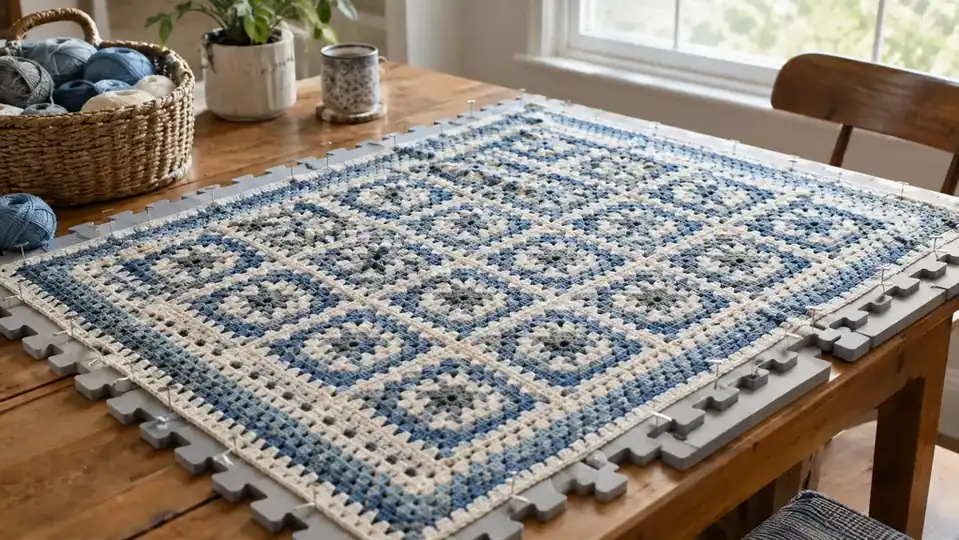
The KnitIQ boards click together tightly enough that a wet blanket stays one flat surface from edge to edge. That is the whole job of a blocking board.
Amazon Check Today's Price on Amazon →How I Tested Both Sets
I blocked the same kinds of projects on both sets over about six weeks. A cotton blanket that needed to dry flat. A stack of granny squares for a church donation blanket. A few hats, which barely need blocking but are a good test of how small a layout you can make. I used the same rust-proof pins, the same kitchen table, and the same patience.
The KnitIQ boards went together first. The tabs clicked in with a firm press, and the whole layout felt like one solid surface. I pinned a 48-inch blanket across nine boards and left it overnight. In the morning, the boards had not shifted and the seams between boards had not opened up.
The Boye boards went together the same way, but the joins felt looser. For a small shawl, that did not matter. For the same 48-inch blanket, I had to press the tabs back together twice while pinning, and one seam opened a little during the night. The blanket still dried fine, but the line where the boards met left a faint ridge in the fabric.
The test that settled it was a wet granny square blanket. I soaked twenty squares, rolled them in a towel, and laid them out four across and five down. On the KnitIQ boards, the whole layout stayed locked together while I pinned, even when I leaned on one corner to reach the far side of the table. On the Boye boards, two of the joins opened up as I pressed pins near the seams, and I had to push the boards back together and re-pin three squares. That is a small annoyance with a dry dishcloth. With a wet blanket and a hundred pins, it is the difference between a calm hour and a frustrating one.
Where KnitIQ Wins
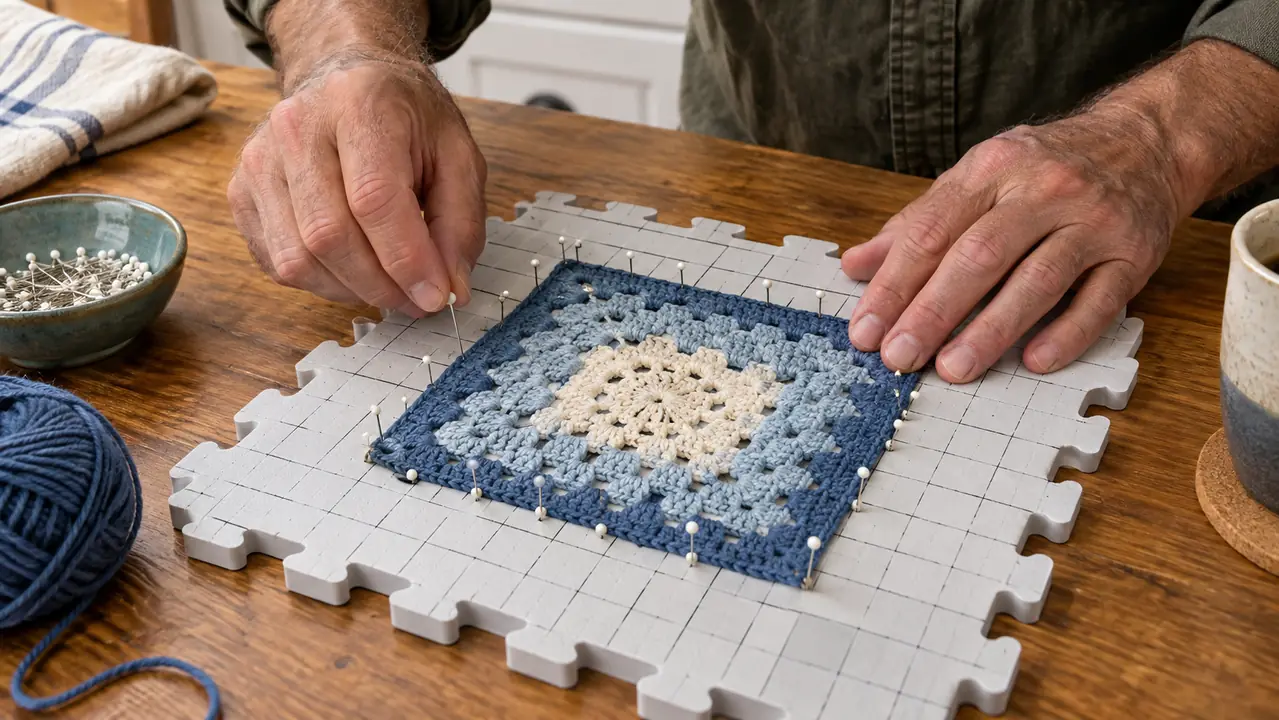
KnitIQ wins on the joins, and the joins are the whole point of interlocking boards. The tabs are cut with a little more precision, so the boards click together with less wobble. That matters more than you would think. When you are pinning a wet blanket, you are leaning over the table and pushing pins in at an angle. Every bit of give in the boards makes the fabric shift. The KnitIQ boards stayed put through the whole process.
The surface also has a slightly grippier texture. Yarn does not slide around while you are arranging it, and pins go in with a satisfying firmness. For a cotton blanket that needs to hold a precise shape, that grip is the difference between a project that looks store-bought and one that looks, well, blocked by a towel.
Pinning feel matters to me because of my right thumb, which stiffens up in cold weather. On the KnitIQ boards a T-pin pushes in with steady, even pressure and holds firm. The foam has enough body that the pins stand straight instead of leaning, which keeps the edges of a shawl in a straight line. On a long pinning session that steadiness saves both time and sore hands.
The KnitIQ grid lines are also easier to read. They are printed crisply and spaced in one inch squares, so when I am pinning a twelve inch square I can count twelve lines and know I am right without reaching for the tape measure. Being a former math teacher, I appreciate a grid I can trust. I checked a few of the KnitIQ squares against my metal ruler and they were accurate. On the Boye boards the lines were a little fainter, and on wet wool under a kitchen light I sometimes had to lean in close to see them.
Where Boye Wins
Boye wins on price, and for a lot of crocheters, that is the deciding factor. If you mostly make hats, scarves, and dishcloths, you do not need a nine-board fortress. The Boye boards handle small projects perfectly well. The looser joins are barely noticeable when you are only using four boards for a stack of squares.
Boye also wins on availability. You can find the Boye set in most craft stores, which means you can buy it with a coupon or pick it up the same day you realize you need it. KnitIQ is mostly an online purchase. If you are the kind of person who decides to block something at 9 PM on a Tuesday, that convenience has real value.
To be fair to the Boye boards, they do the basic job. A piece pinned on them dries flat and comes off the boards in better shape than it went on. If your projects are small, a hat, a few dishcloths, a single baby square, you may never notice the looser joins at all, because you will not be pinning across them. For someone who blocks a handful of times a year and wants to spend as little as possible, that is a perfectly sensible choice, and I would not talk them out of it.
The KnitIQ boards stayed put through the whole process. That is the whole job of a blocking board.
The Details That Matter
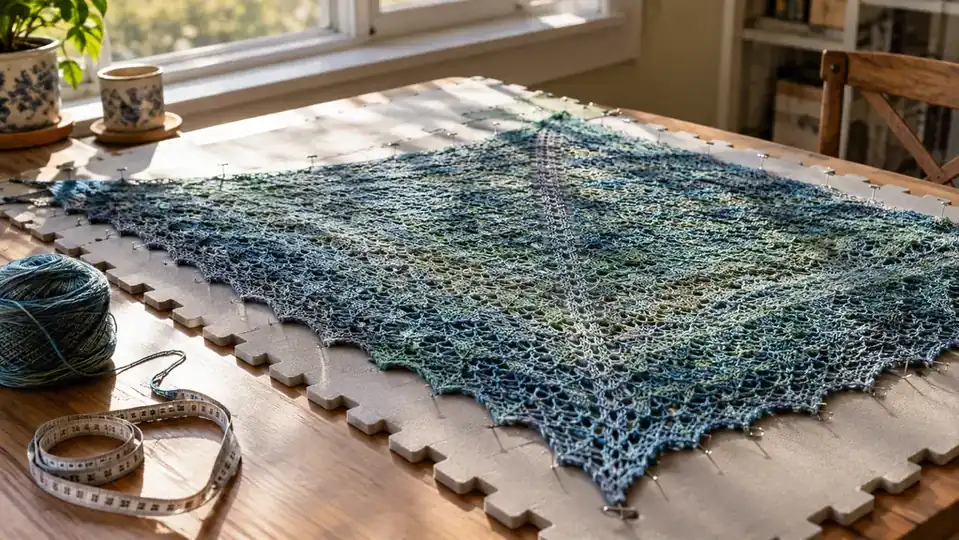
Both sets come with nine boards, and both are made of a similar foam-like material that takes pins well. The KnitIQ boards are a standard size that works with most blocking patterns. The Boye boards are the same standard size. If you are following a pattern that says to block a piece to 12 by 12 inches, either set will get you there.
Storage is another quiet difference. The KnitIQ set packs into its bag as a neat square stack that slides onto the closet shelf beside my yarn bins. My Boye boards came loose in a plastic sleeve that tore the second time I used it, so they now live in an old pillowcase. Neither detail changes how a shawl blocks, but when you take the boards out and put them away a few times a month, a tidy set that keeps itself together is one less small chore.
The difference is in the long-term behavior. After six weeks of use, the KnitIQ boards still click together as tightly as they did on day one. The Boye boards developed a little more give in the tabs, especially the ones I used most. They still work, but they feel less solid than they did new.
I also watched how each set held up to being taken apart and stored. I break my boards down after every project and stack them in the hall closet. After six weeks of that, the KnitIQ tabs still clicked together as firmly as they did on the first day. Two of the Boye tabs had started to soften at the edges, which is part of why those joins opened up during the blanket test. It is not a dramatic failure, but it is the kind of wear that gets worse with time rather than better, and blocking boards are something most of us expect to keep for years.
One more thing worth noting: the KnitIQ set comes in a clear bag that makes storage easy. The Boye set also stores fine, but the bag is not as sturdy. If you are going to keep your boards in a closet or under a bed, the KnitIQ bag will hold up better over time.
Who Should Buy Which
Buy the KnitIQ set if you block large projects regularly, if you have been frustrated by boards that separate while you work, or if you want a set that will still feel solid a year from now. It is the set I reach for when I am blocking a blanket or a shawl, which is most of what I make.
Buy the Boye set if you are new to blocking, if you mostly make small pieces, or if you want to try blocking without spending much. It is a fine place to start, and if you later decide you need the tighter joins, you will know exactly why you are upgrading.
And if you are buying for a friend who is just getting into crochet, the Boye set is a kind first gift. It teaches the habit of blocking without a big commitment, and if they fall in love with shawls and blankets the way I did, they will know exactly what they want next time.
One more way to decide is to look at your last three finished projects. If they were blankets, shawls or anything you seamed from pieces, the joins and the grid on the KnitIQ set will earn their keep every time you block. If they were hats, cowls and dishcloths, the Boye set will probably cover you, and you can always add a second set later if your projects grow. Whichever you choose, either one beats pinning to a towel on the guest bed, and that is the most important upgrade of all.
The set that stays flat while you work
If you are tired of pressing boards back together mid-pin, the KnitIQ set is the upgrade that actually fixes the problem.
Amazon Check Today's Price on Amazon →