
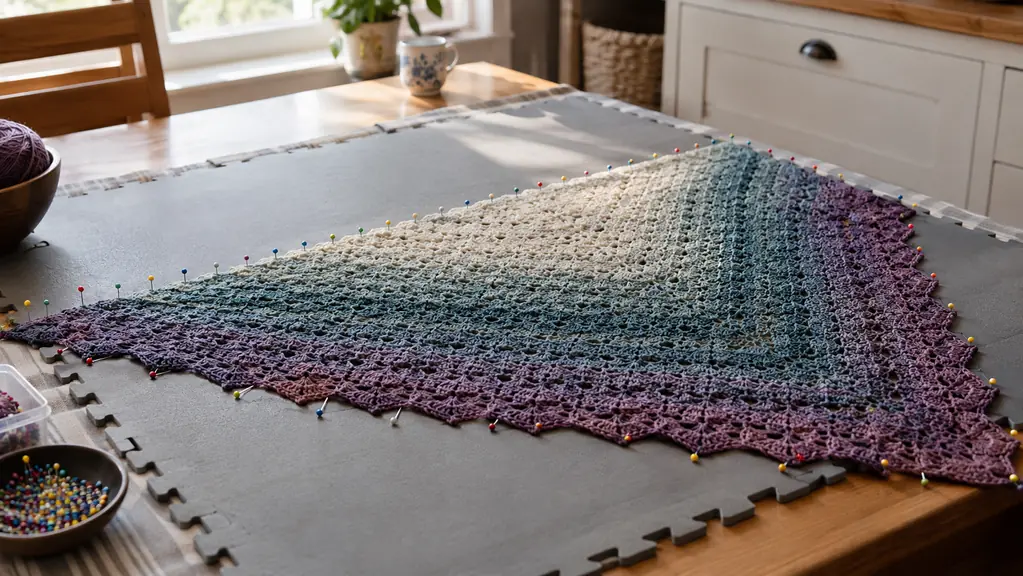
I have crocheted for about 30 years, and for most of that time I blocked the way my aunt taught me: a clean towel on the kitchen table, a lot of pins, and a prayer that the edges would dry straight. It worked well enough for dishcloths. It did not work well for a lace shawl, and it was a disaster for granny squares that refused to lie flat. Last year I finally bought a set of KnitIQ blocking mats, and after twelve months of steady use, I have strong opinions about them.
This is not a review written after one weekend of blocking. This is a year of shawls, baby blankets, hat panels, and one very stubborn afghan that spent three days pinned out on my kitchen table. I am Joanne, a retired middle school math teacher in Worcester, Massachusetts, and I still treat a gauge swatch like a word problem. If a mat does not hold a pinned edge, I notice. If it does not lie flat, I notice. Here is what I learned. It is a year of real projects, pinned at my own kitchen table, with my own stiff thumb doing the pinning.
The Quick Verdict
KnitIQ blocking mats are the best all-around blocking surface I have used in 30 years of crochet. They pin cleanly, stay flat, and the 9-piece set covers a surprising amount of table. They are not magic: stubborn acrylic still needs steam and patience, and the mats do slide a little on a smooth table. But for the price, they earn their place in any crocheter's kit.
Amazon Check Today's Price →Stop fighting crooked edges. Block on a surface that actually holds pins.
After a year of daily use, the KnitIQ 9-piece set is still flat, still grippy, and still my first choice for shawls and squares. Check today's price on Amazon and see why 5,500+ crocheters rate it 4.8 stars.
Amazon Check Today's Price on Amazon →How I've Used It
I bought the KnitIQ Standard 9-pc Set last January, right after I finished a pineapple lace shawl that took me six weeks to crochet and one very tense afternoon to block on towels. The shawl came out fine, but I told my husband Glenn that if I was going to keep making lace, I needed a real blocking surface. He agreed, mostly because he was tired of finding straight pins in the kitchen rug.
Since then, the mats have been used at least twice a month. I have blocked a dozen granny square baby blankets for my church's donation drive, three shawls, a pile of hat panels, and one king-size acrylic afghan that took over the entire kitchen table for three days. The mats have been pinned, unpinned, repinned, steamed, spritzed, and once accidentally left out overnight with a damp blanket on top. They still look almost new.
My usual setup is simple. I lay the mats on the kitchen table, interlock the edges, and pin my pieces right side down. For acrylic, I use a handheld steamer and let the steam do the work. For wool and cotton, a spritz of water and a few hours of drying time. The mats take the pins easily, hold them firmly, and release them without leaving permanent holes. That last part matters more than you might think.
A typical blocking day goes like this. I soak the finished piece in cool water with a little wool wash for about twenty minutes, roll it in a towel to press the water out, and carry it to the kitchen table where the KnitIQ mats are already laid out. I pin the corners first, then the middle of each edge, then fill in, checking the grid lines as I go. Most pieces dry overnight. The next morning I pull the pins, and the piece lifts off the mats flat and square. For a blanket made of granny squares I might do this in three or four batches over a week, and the mats come apart and stack in the closet between rounds.
What Makes the KnitIQ Mats Different
The first thing I noticed was the material. KnitIQ mats are made of a dense, closed-cell foam that feels firmer than the cheap play-mat style blocking boards I tried years ago. When I push a T-pin in, it goes in smoothly and stays put. When I pull it out, the foam closes back up. After a year, I cannot point to a single spot where the surface has worn out or started to crumble.
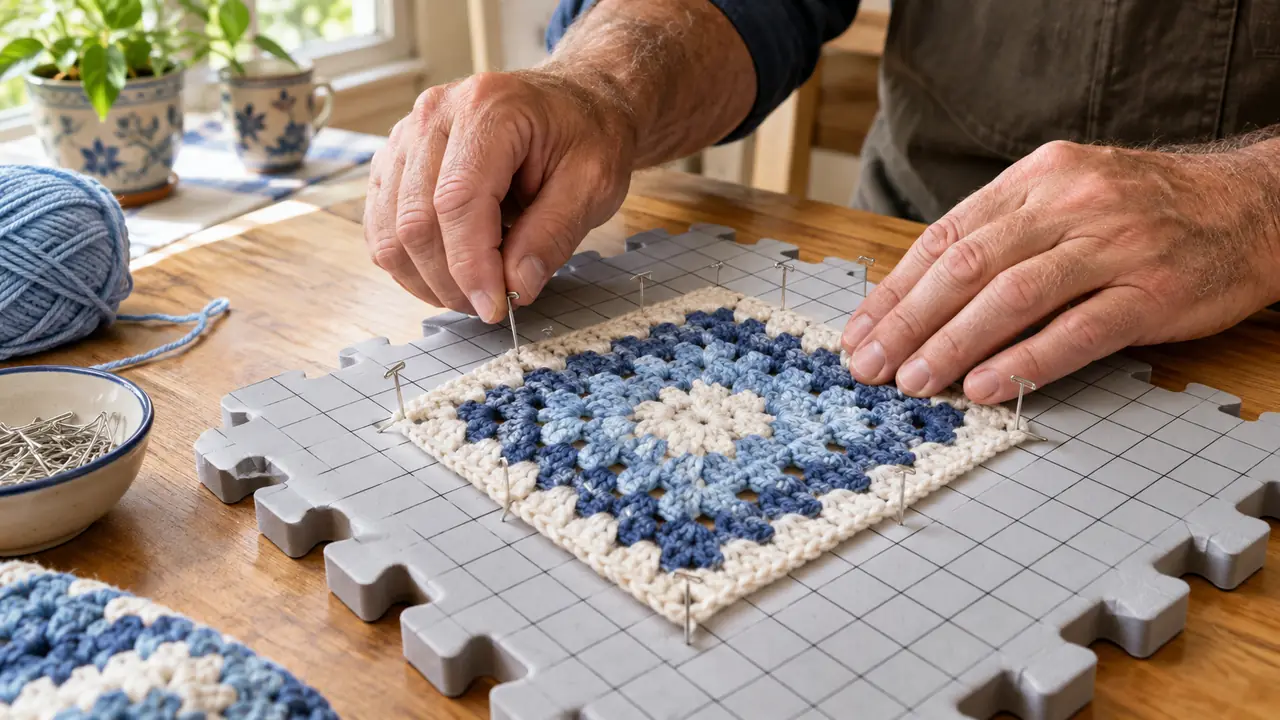
The second thing is the grid. Each mat has a printed grid of lines and circles that help me line up edges and corners. I am a math teacher, so I will admit I get a little nerdy about this. When I block a shawl, I can use the grid to make sure both wings are the same width. When I block squares, I can check that each one is the same size before I sew them together. It is like having a ruler built into the table.
The third thing is the interlocking edges. The mats connect with a tongue-and-groove style edge that clicks together and stays together. I have used sets where the pieces drifted apart the moment I started pinning. These do not. I can pick up a fully pinned shawl by two corners of the mat and the whole thing holds together. That is a test I have done more than once, and it has never failed.
Blocking Performance Over a Year
Let me be specific about what these mats have actually done for my finished pieces. Before I switched to KnitIQ, my granny squares were a constant source of frustration. I would crochet twenty identical squares, lay them out, and discover that no two were exactly the same size. Blocking on towels helped, but the edges were never crisp and the squares never stayed uniform.
With the KnitIQ mats, I can pin each square to the same grid lines and block them all to the same dimensions. The result is that my baby blankets now go together with straight seams and square corners. The donation drive blankets look noticeably more professional, and I have had two different women at church ask me what I changed. That is the kind of compliment a crocheter remembers.
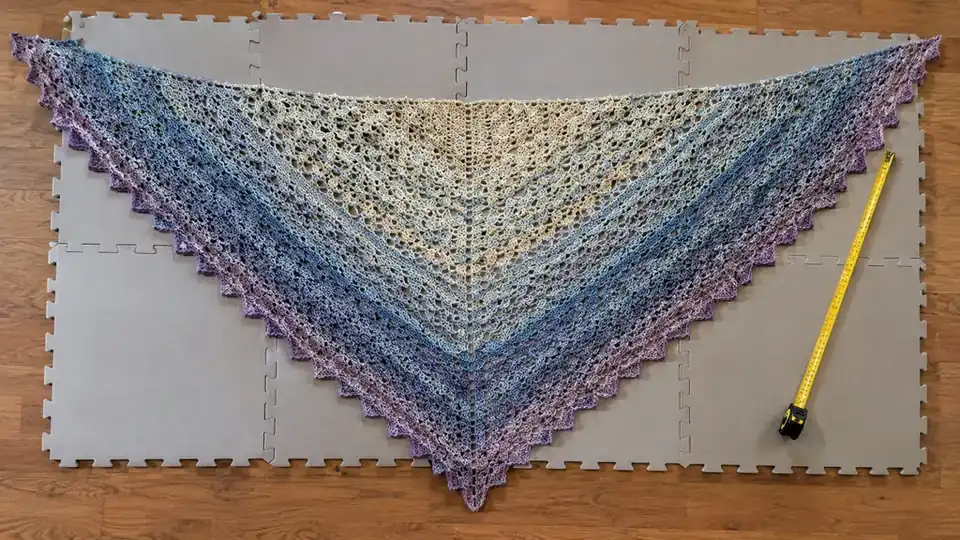
The shawls are where the mats really shine. Lace patterns need to be stretched and pinned aggressively to open up the stitches, and the KnitIQ mats hold that tension without bowing or flexing. I blocked a fingering-weight shawl to 68 inches across, pinned it hard for two days, and the points stayed sharp and the edges stayed straight. On towels, that same shawl would have dried with wavy edges and rounded points.
The one thing the mats cannot do is fix a fiber that does not want to be blocked. Acrylic needs heat to relax, and no amount of pinning will change that. I learned this the hard way with the king-size afghan. I pinned it, spritzed it, and left it for three days. It dried flat, but the acrylic still bounced back to its old shape in places. The mats held the pins perfectly. The yarn simply refused to cooperate. That is not a mat problem, it is a fiber problem.
I keep a simple record of what I block, because the teacher in me likes data. Over the last year that list has about thirty entries: eighteen hats and baby items for the church drive, six dishcloth sets that I blocked lightly before gifting, three shawls, two blankets done square by square, and a cardigan I made as a gift. On every one of those, the finished size landed within a quarter inch of what the pattern asked for. Before the mats, I could not have said that honestly about even half of them.
I blocked a fingering-weight shawl to 68 inches across, pinned it hard for two days, and the points stayed sharp and the edges stayed straight. On towels, that same shawl would have dried with wavy edges and rounded points.
The Pros and Cons After 12 Months
What I Liked
- Pins go in smoothly and hold firmly, with no permanent holes left behind
- The printed grid makes it easy to block squares and shawls to exact measurements
- Interlocking edges stay connected even under heavy pinning
- The 9-piece set covers a large area, enough for a full-size shawl or a stack of squares
- Dense foam has held up to a year of steam, water, and heavy use without crumbling
- Easy to clean with a damp cloth and store flat or rolled
Where It Falls Short
- Mats slide slightly on a smooth kitchen table unless you pin near the edges or add a grippy pad underneath
- The grid lines can be hard to see in low light, especially with dark yarn on top
- Steam can leave a faint mark on the foam if you hold the steamer too close, so keep the nozzle moving
- The included pins are basic; I replaced mine with longer T-pins for thicker pieces
Who This Is For
KnitIQ blocking mats are for anyone who blocks more than once a year and wants results they can measure. If you make shawls, doilies, granny square blankets, or anything with lace, these mats will change the way your finished pieces look. The grid alone is worth the purchase for anyone who has ever held two supposedly identical squares side by side and sighed.
They are also for crocheters who are tired of pinning into towels, carpet, or the ironing board. I have done all three, and none of them hold a pin the way a real blocking mat does. If you are at the point where your projects deserve a proper finish, this is the tool that gets you there. The 9-piece set is a good size for most projects, and you can always buy a second set if you need more room.
Who Should Skip It
If you only crochet washcloths and simple scarves that you never block, you do not need these mats. A towel and a flat surface will do the job. And if you work almost exclusively with superwash wool or acrylic that you never steam, you may not see enough of a difference to justify the purchase. Blocking mats are a finishing tool, not a magic fix for every project.
I would also say that if you have a very small workspace, the 9-piece set can feel bulky to store. The mats are flexible and can be rolled, but they take up more room than a stack of towels. And if you block on a carpeted floor, the mats will slide less, but you will still want to pin near the edges to keep everything stable. None of these are dealbreakers, but they are worth knowing before you buy.
How It Compares to What I Used Before
Before the KnitIQ mats, I used a set of interlocking foam play mats that I bought at a big box store. They were cheaper, but the foam was soft and the pins did not hold well. Every time I pinned a square, the pin would lean or pop out. The surface also started to crumble at the edges within a few months. The KnitIQ mats are noticeably denser and have held up far better over the same period.
The play mats also had a texture on top that left a faint pattern on wet wool, which I did not notice until I lifted a shawl and saw it. The KnitIQ surface is smooth enough that nothing printed through, even on a fine lace weight.
I also tried blocking directly on a padded ironing board. It works for small pieces, but you cannot pin a shawl flat on an ironing board without the edges hanging off. The KnitIQ mats give me a flat, continuous surface that I can size to the project. For a 68-inch shawl, I used all nine pieces in a three by three grid. For a stack of squares, I used six pieces in a two by three grid. The flexibility is genuinely useful.
Tips I Learned the Hard Way
After a year of blocking on these mats, I have a few tips that will save you the frustration I went through. First, pin at an angle, not straight down. Angled pins hold better and are easier to remove. Second, use the grid. It is there for a reason, and it will make your blocking more accurate. Third, if you are steaming acrylic, keep the steamer moving and do not let it rest on the foam. The heat can leave a mark.
Fourth, if your table is smooth, put a damp towel or a non-slip pad under the mats. The mats stay put for most projects, but a heavy afghan can pull them around. Fifth, let your pieces dry completely before you unpin. I have ruined a perfectly good blocking job by unpinning too early and watching the edges curl back up. Patience is part of the process.
Give your next shawl the finish it deserves.
A year of blocking has convinced me: the KnitIQ 9-piece set is the most useful finishing tool I own. If you are tired of wavy edges and uneven squares, check today's price on Amazon and see the difference for yourself.
Amazon Check Today's Price on Amazon →