
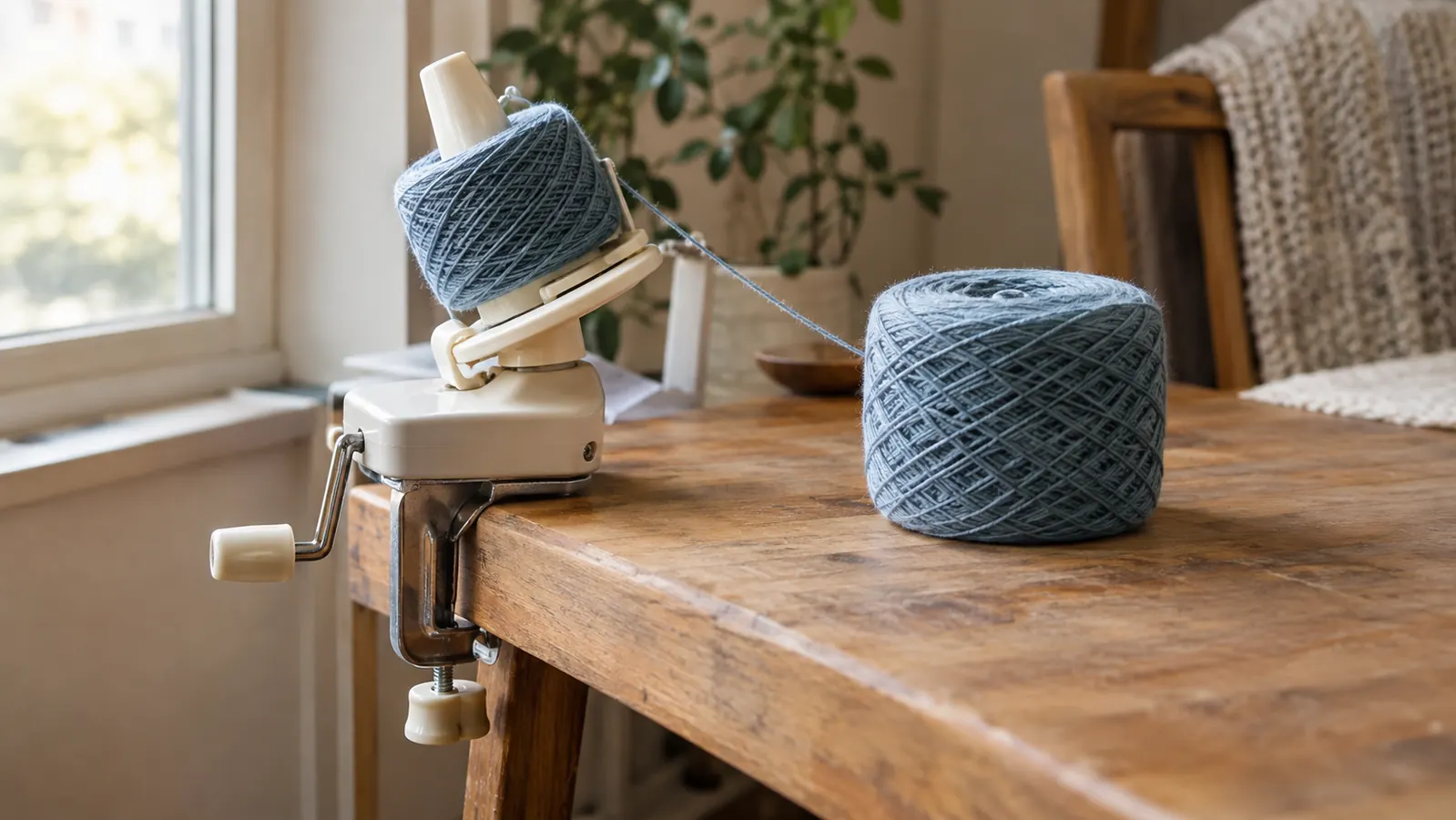
I will be honest with you. I almost did not buy a yarn ball winder at all. For years I wound yarn by hand into what I generously called balls, and I told myself the wobble was part of the charm. Then my aunt's old pattern for a ripple blanket called for six colors, and I spent one whole evening untangling a skein that had decided to become a bird's nest in my project bag. That night I started reading reviews, and the Knit Picks Yarn Ball Winder kept showing up. So I ordered one, and I have used it for months now. Here is what nobody tells you before you buy it.
The Quick Verdict
A solid, dependable winder that makes tidy center-pull cakes, with a clamp that needs a real table and a crank that rewards a steady rhythm. Not perfect, but for most crocheters it is the one to get.
Amazon Check Today's Price →Tired of untangling yarn by hand?
The Knit Picks Yarn Ball Winder turns messy skeins into neat center-pull cakes in a couple of minutes. See today's price on Amazon and read the current customer reviews.
Amazon Check Today's Price on Amazon →How I've Used It
I am Joanne, a retired middle school math teacher in Worcester, Massachusetts, and I have been crocheting for about 30 years. My usual projects are blankets, dishcloths, hats, and baby gifts for my church's donation drive, which means I wind a lot of worsted weight and DK yarn. I have used the Knit Picks winder at my kitchen table, on a sturdy folding table at a craft retreat, and once on the counter at my sister's house when I forgot to pack mine. The clamp has held on all three, but the kitchen table is the one I keep coming back to.
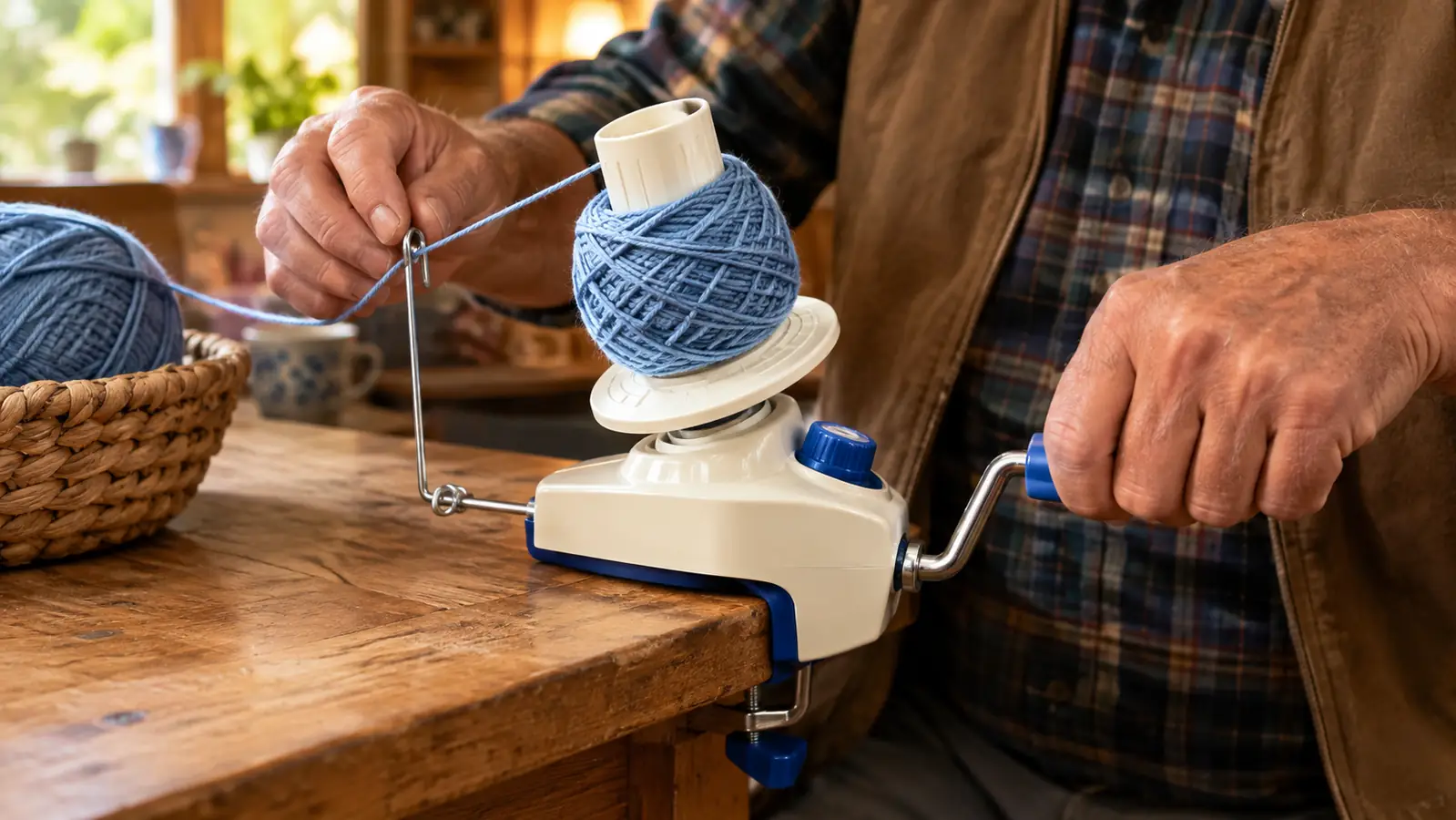
The winder comes with a clamp that screws tight against the edge of a table. You feed the yarn from a skein through the metal guide, hook it onto one of the pegs, and turn the crank. The arms open and close as you crank, wrapping the yarn into a cake with a center pull. It sounds simple because it is simple. The learning curve is about ten minutes, and most of that is figuring out how much tension to keep on the yarn as it feeds.
I have wound everything from a single 50 gram skein of fingering weight to a full 100 gram skein of worsted weight, and the winder handled both without complaint. The capacity is listed as 100 grams, and I would not push it much past that. When I tried to wind two skeins at once to save time, the cake got lopsided and the yarn started catching on the arms. That was my mistake, not the winder's, but it taught me to respect the capacity.
I remember the first time I wound a whole blanket's worth of yarn in one sitting. It was a Sunday in early November, and I had twelve skeins of worsted weight waiting for a ripple blanket for the donation drive. By hand, that would have taken me most of an afternoon, and at least one tangle was guaranteed. With the winder clamped to my kitchen table, I finished all twelve in about an hour and a half, and every single cake pulled from the center cleanly. I sat back and looked at the row of cakes lined up on the table. That was the moment I stopped thinking of the winder as a luxury and started thinking of it as a regular tool.
What Nobody Tells You About the Clamp
The clamp is the part of this winder that gets the least attention in reviews, and it is the part that will decide whether you love the thing. It needs a table edge that is flat and at least about three quarters of an inch thick. My kitchen table is perfect. My recliner's wooden arm is not, and I learned that the hard way when I tried to wind yarn while watching television. The clamp slipped, the winder tipped, and the yarn went everywhere. The winder is not broken, but my pride took a hit.
You also need to screw the clamp tighter than feels polite. The first few times I used it, I was gentle, and the winder wobbled with every crank. Once I gave the knob a firm turn, it sat rock solid. If you have a table with a rounded edge or a lip underneath, the clamp will not grip as well. A plain flat table edge is what this winder wants.
One more thing about the clamp: it can leave a faint mark on a nice wooden table. Not permanent damage, but after an afternoon of winding, you may notice a light ring where the pad pressed. I keep a thin piece of felt in my craft bag now, and I lay it between the clamp and the table whenever I am working somewhere that matters. My sister's kitchen counter came through fine without it, but I would rather be careful. That is the kind of detail you only learn from using the thing for months, not from reading the product page.
Give it a flat table edge and a firm turn of the knob, and I have wound twelve skeins in a row without the winder moving a millimeter.
The Crank, the Grip, and My Thumb
I have mild stiffness in my right thumb joint in cold weather, so I pay attention to how a crank feels after twenty minutes of winding. The Knit Picks winder has a smooth action, and the handle is comfortable in my hand. I would not call it effortless, because winding a full skein does take some work, but it is steady and does not jerk. I have wound three skeins in a row without needing to stop and shake out my hand, which is more than I can say for the hand-cranked models I tried at a yarn shop years ago.
The crank turns clockwise, and the yarn feeds through a metal guide that moves up and down as the arms open and close. The rhythm matters more than the speed. If you crank too fast, the yarn can slip off the guide and tangle. If you crank slowly and evenly, you get a cake that pulls from the center without collapsing. I am a math teacher, so I will put it this way: the winder is a machine, and it rewards a steady input.
One thing that surprised me is how much tension the yarn needs. If you let the skein sit loose in your lap, the yarn feeds unevenly and the cake comes out soft and floppy. If you hold the skein with a little tension, or run it through your fingers as it feeds, the cake comes out firm and neat. This is not in the instructions, and it took me a few tries to figure out. Once I did, my cakes looked like the ones in the product photos.
On a damp morning last February, my thumb was stiff enough that I almost skipped winding altogether. I had one skein of DK yarn I needed for a hat, so I went ahead and set up the winder anyway. To my relief, the handle is wide enough that the pressure spreads across my palm instead of concentrating on the joint. I wound that skein slowly, the way I would work through a problem at the chalkboard, and my thumb was no worse afterward. I cannot promise the same for everyone, because hands differ, but the grip is genuinely better than the skinny metal handles on the older winders I have tried.
Capacity and Real-World Limits
The listed capacity is 100 grams, and that is accurate for most yarns. A standard 100 gram skein of worsted weight winds into a cake that fills the arms nicely. A 50 gram skein of fingering weight winds into a smaller cake that still pulls from the center perfectly. The winder does not care about the weight as much as the volume, so a bulky yarn will reach the capacity faster than a fingering weight will.
What nobody tells you is that the capacity is also about the yarn's thickness. I wound a 100 gram skein of bulky yarn and the cake was noticeably fuller than a 100 gram skein of worsted weight. It still worked, but the arms were close to their limit. If you mostly work with bulky or super bulky yarn, you might find yourself winding smaller amounts more often. For my projects, which are mostly worsted and DK, the capacity has been plenty.
I have also learned that the winder works best with yarn that is already in a loose skein or hank. If you try to wind from a tight ball, the yarn feeds with too much resistance and the cake comes out uneven. I usually wind from a skein that I have opened up and looped around my hands a few times to loosen it. That extra thirty seconds makes a noticeable difference in the final cake.
I also learned to weigh my skeins before I wind them. A ball band says 100 grams, but some yarns run heavy, especially if they have been sitting in a humid room. I keep a small kitchen scale in my craft cabinet, and I have found that a skein weighing 105 grams still winds fine, while anything much heavier makes the arms strain. It is a small habit, but it has saved me from a few lopsided cakes, and it takes ten seconds to use.
What It Does Well
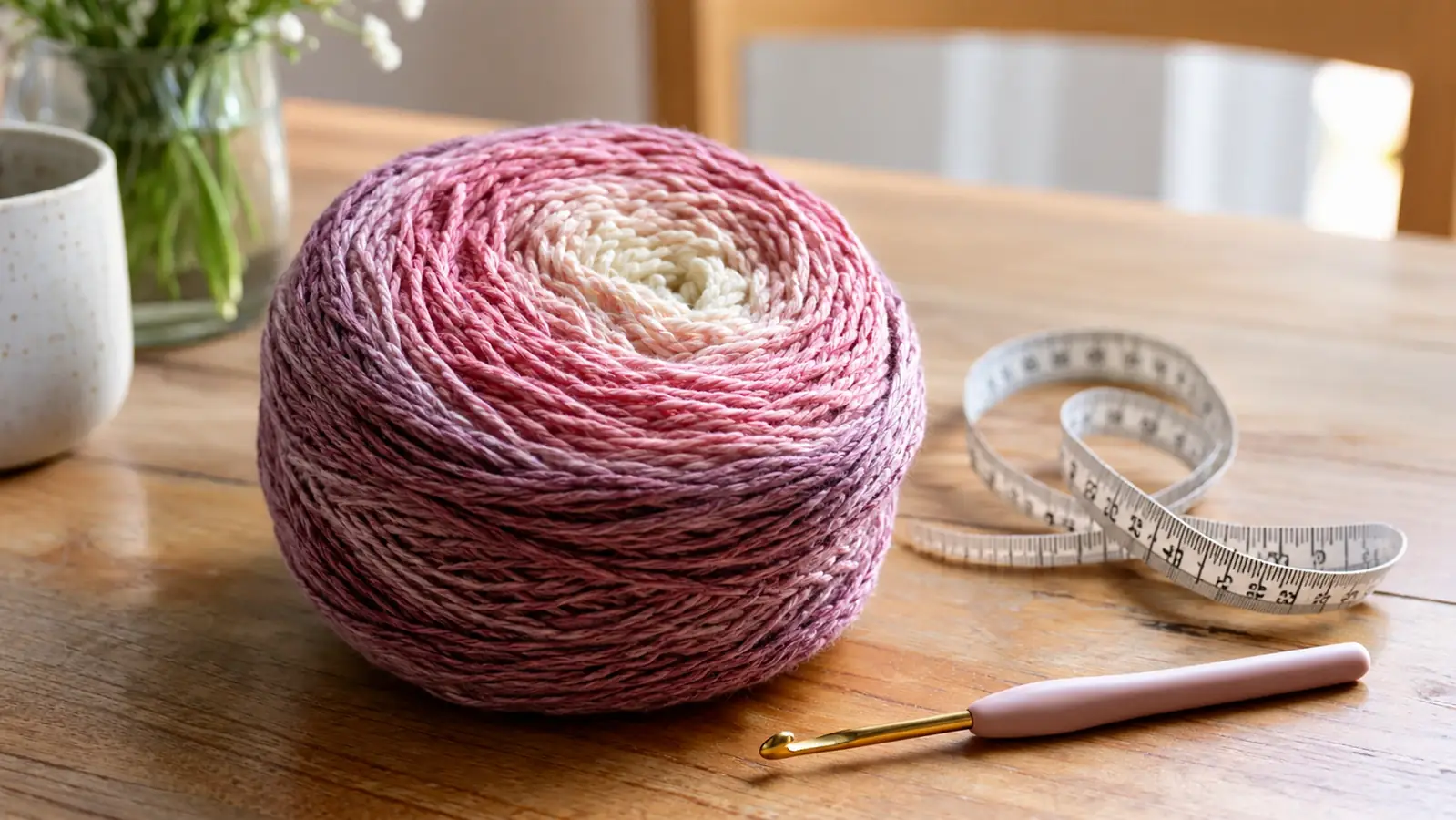
The center-pull cakes are the real reason to buy this winder. A cake that pulls from the center sits still while you work, so it does not roll off the table and tangle with your project. I have crocheted entire blankets from center-pull cakes and never once had to stop to untangle. That alone has saved me hours.
The winder is also compact. It stores in a drawer in my craft cabinet, and it takes up less space than a skein of bulky yarn. When I take it to a craft retreat, it fits in my tote bag next to my hooks and patterns. The whole thing is light enough to carry without thinking about it.
And it is built to last. I have used mine for months, wound dozens of skeins, and the gears still turn smoothly. The metal guide shows a little wear where the yarn rubs, but nothing that affects how it works. The build quality is better than I expected from a hand-cranked winder.
And the cakes are consistent in a way that satisfies my math-teacher brain. When I wind the same skein twice and measure the results, the diameter comes out within a quarter inch both times. The center hole stays open, which means the yarn pulls freely without the cake collapsing into a pile. For a person who likes predictable results, that consistency is half the pleasure of using the tool.
Where It Falls Short
The clamp is the biggest weakness. It needs a flat table edge, and it will not work on a recliner arm, a rounded table edge, or a surface with a lip underneath. If you do not have a suitable table, you will need to buy a separate clamp or a different style of winder. That is a real limitation, not a nitpick.
The crank is also not as smooth as the expensive electric winders I have seen at yarn shops. It is perfectly fine for a few skeins at a time, but if you wind yarn professionally or in large batches, your hand will get tired. I wind a few skeins at a time for my own projects, so this has not been a problem for me, but I want to be honest about it.
And the instructions are minimal. The winder comes with a small pamphlet that shows the basics, but it does not mention tension, table thickness, or how to wind from a hank. I figured those out by trial and error. If you are new to yarn winders, plan to spend a little time experimenting before you get the hang of it.
The other thing I will mention is the sound. It is not loud, but it is not silent either. The gears make a soft clicking as the arms open and close, and if I wind yarn at ten o'clock at night while Glenn is reading in the same room, he hears it. He has never complained, but I have learned to do my winding earlier in the evening out of consideration. It is a small thing, but it is the kind of detail that shows up in real life and never shows up in the product reviews.
What I Liked
- Makes tidy center-pull cakes that sit still while you work
- Compact enough to store in a drawer and carry to a retreat
- Comfortable crank that has treated my stiff thumb well
- Solid build that has held up through months of regular use
- Simple to learn, about ten minutes to get the hang of
Where It Falls Short
- Clamp needs a flat table edge at least three quarters of an inch thick
- Capacity is really about volume, so bulky yarn fills the arms fast
- Minimal instructions; tension and table setup come from trial and error
- Hand winding gets tiring if you work in large batches
Who This Is For
This winder is for the crocheter or knitter who works with worsted, DK, or fingering weight yarn, winds a few skeins at a time, and has a flat table edge to clamp it to. It is for the person who is tired of hand-winding balls that roll away and tangle, and who wants a neat center-pull cake every time. It is for the person who wants a dependable tool that does not cost a fortune and does not take up half a room.
If that sounds like you, the Knit Picks Yarn Ball Winder will probably make you wonder why you waited so long. I know I did.
Who Should Skip It
Skip this winder if you mostly work with bulky or super bulky yarn, because the capacity will feel small. Skip it if you do not have a flat table edge to clamp to, because the clamp is not optional. And skip it if you wind yarn in large batches or for a business, because your hand will get tired and you will want an electric winder instead.
There is no shame in any of those. The right tool depends on how you work, and this one is not for everyone. But for the right person, it is a genuinely useful tool.
The winder I reach for every single project
If you are tired of tangles and hand-wound wobble, the Knit Picks Yarn Ball Winder is worth a look. Check today's price on Amazon and see what other crocheters say.
Amazon Check Today's Price on Amazon →