
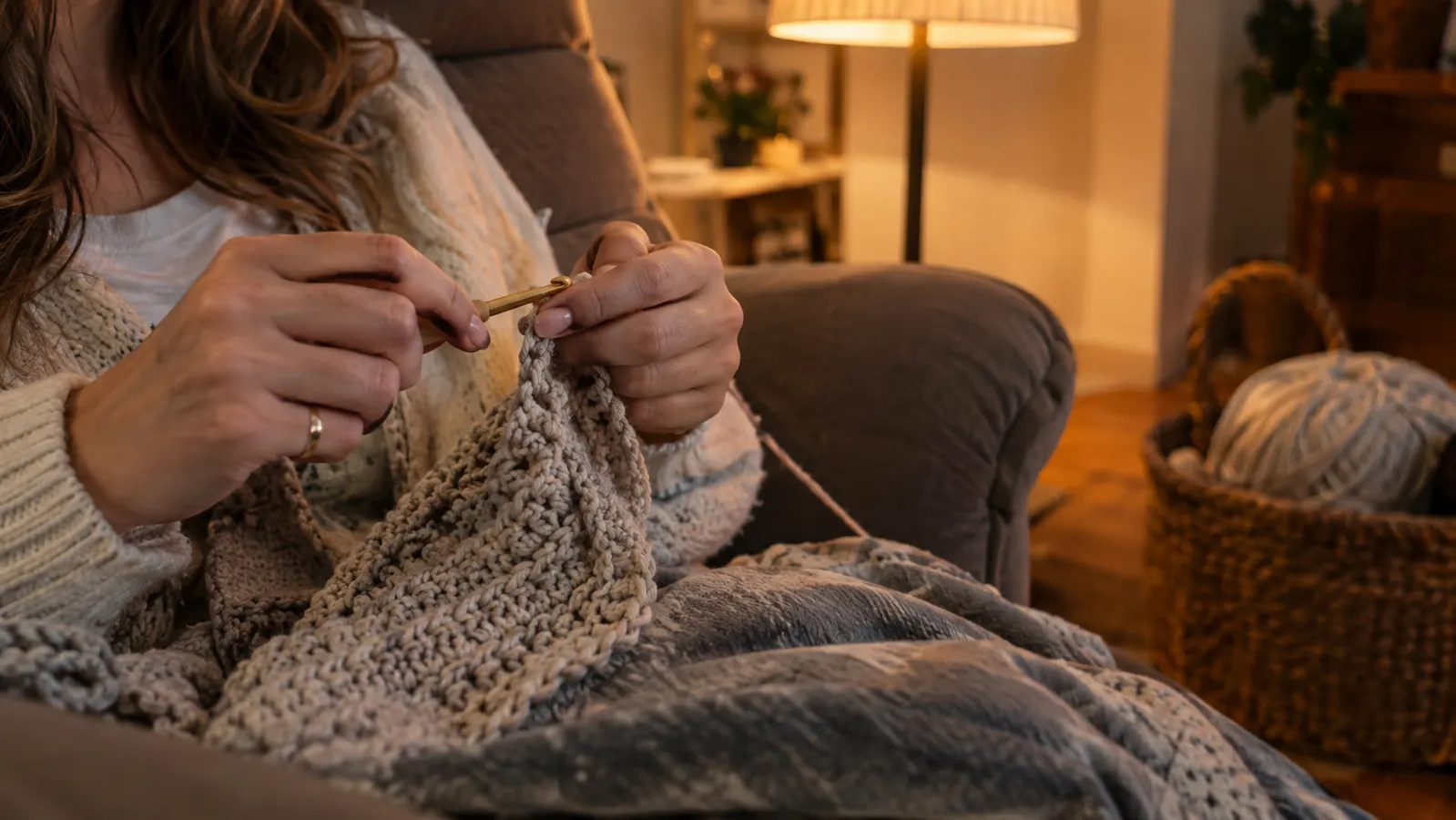
I did not set out to write about thumb stiffness. I set out to finish a baby blanket for my church's donation drive before the December deadline, and I had the yarn, the pattern, and a solid week of evenings to make it happen. Somewhere around the third evening of crocheting, my right thumb reminded me that it has opinions about being bent around a hook for two hours straight. The joint ached, the grip got clumsy, and I found myself stopping every few rows to shake my hand out. I have crocheted for about 30 years, learned from my aunt back when I was in my twenties, and I am not the type to set a project aside easily. But I also spent 30 years in a middle school math classroom, so I know how to work around a stubborn problem instead of fighting it head on.
The first thing I learned is that the fix is not one single trick. It is a handful of small changes that add up, and the hook in your hand is the biggest one. The Clover Amour hook set, with its comfortable ergonomic handles, let me keep crocheting through the winter months when my thumb usually acts up. In this guide I will walk through the exact steps I use now, from the way I grip the hook to the way I time my sessions, so you can steal what works and skip what does not.
The hook set that kept me crocheting all winter
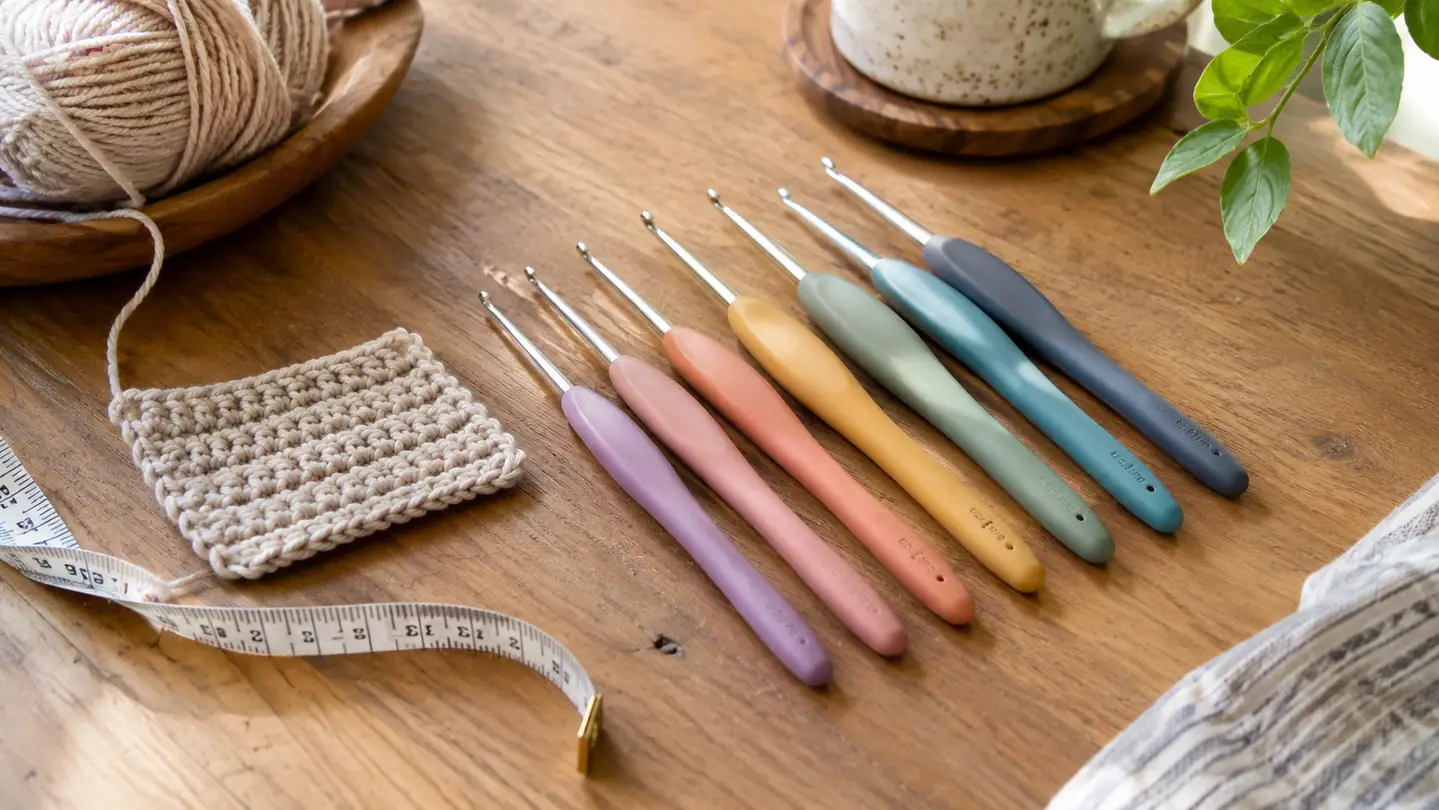
The Clover Amour hook set comes with 10 sizes, so I always have the right hook for whatever yarn I am using. It is the set I reach for first on cold evenings, and the one I keep coming back to.
Amazon Check Today's Price on Amazon →Step 1: Loosen your grip before you change anything else
The biggest mistake I made for years was holding the hook like it might run away. A tight grip puts constant pressure on the thumb joint, and that pressure is exactly what makes stiffness worse in cold weather. Before you buy anything or change your technique, pay attention to how hard you are actually squeezing. Stop every few rows and check in with yourself. Are your knuckles white? Is your thumb bent at a sharper angle than it needs to be? Most of us never notice how hard we are gripping until someone asks.
The ergonomic handles on the Clover Amour hooks are wider than the plain metal hooks I used for most of my life, and that width does the work for you. Instead of pinching a skinny metal stick between my thumb and finger, my fingers rest on the larger surface, which means I do not need to grip as hard to keep control of the hook. It sounds like a small thing, but it is the difference between a hand that is still relaxed at the end of a row and a hand that is already tired before I finish the first ball of yarn.
Try this tonight. Crochet one row with your usual hook and notice how your thumb feels while you work. Then switch to an ergonomic hook and crochet the same row, the same yarn, the same stitch. Most people feel the difference in their grip pressure within a few minutes, even though the finished row looks identical. I know I did. It was the first time in years I finished a row without catching myself flexing my thumb afterward.
Step 2: Match the hook to the yarn and the job
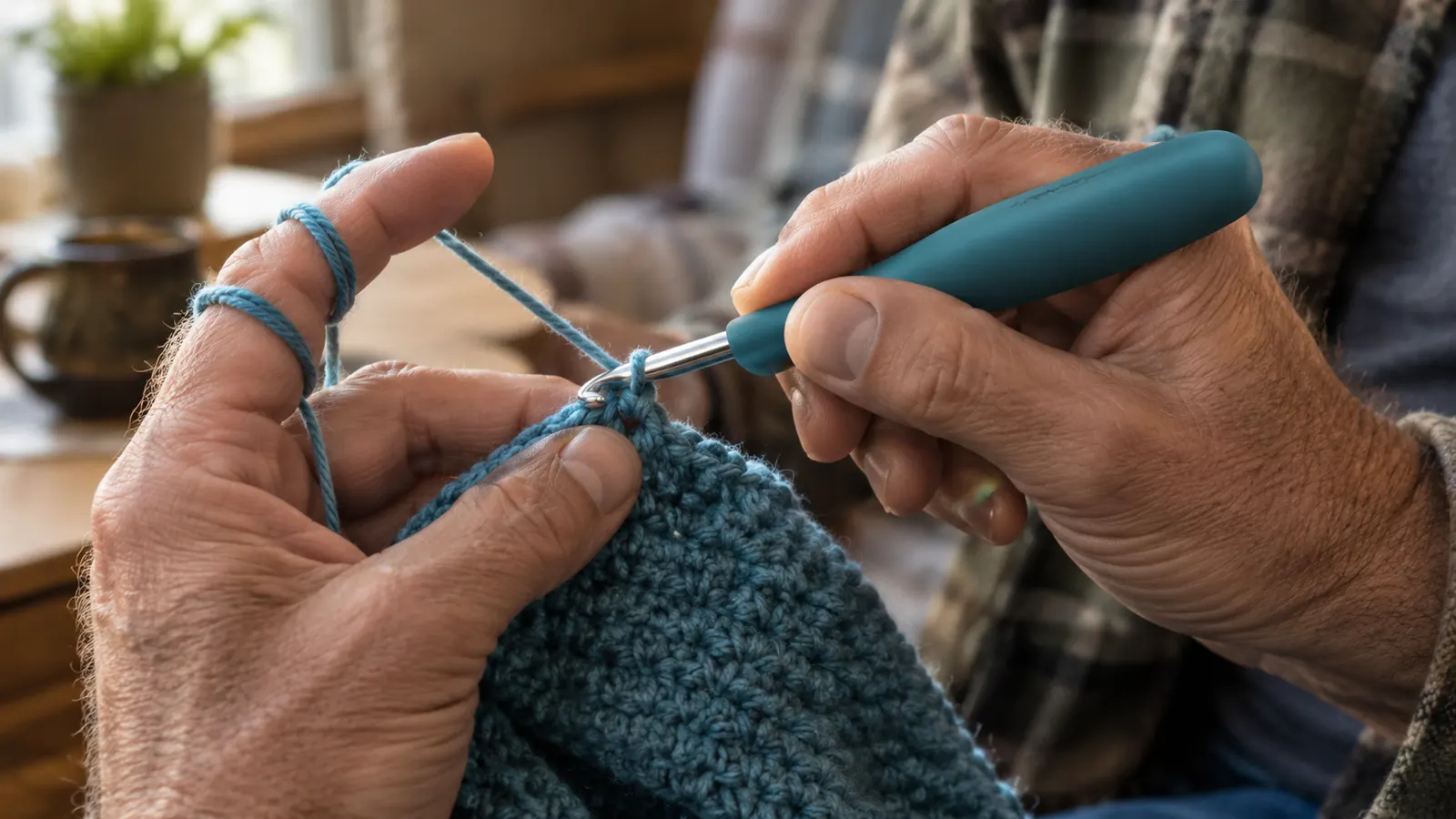
Half of thumb strain is grip pressure, and the other half is using the wrong size hook for the yarn. When the hook is too small, you have to force the yarn through every loop, and that forcing travels straight into your thumb joint. When the hook is too big, the stitches get loose and you end up yanking the yarn to tighten them, which is just as hard on your hand. Either way, your thumb pays for a mismatch that has nothing to do with your skill.
This is where the math teacher in me comes out. The yarn label gives you a recommended hook size, but the real answer lives in your gauge swatch. If your stitches are tight and difficult to work, go up one hook size and crochet a fresh swatch. A four inch square will tell you more about your hand health than any chart will. I keep a small notebook next to my chair where I write down the yarn, the hook size, and how my hand feels after 20 minutes. After a few projects, the pattern becomes obvious, and I can pick the right hook before I even start a row. I date each entry, and I am not precious about the system. It just needs to be something you will actually keep up with.
The Clover set includes 10 sizes, which is exactly what I need for this kind of testing. I keep the whole set together by my recliner, so when a project starts to fight me I can switch hooks without getting up. Having the right size within reach means I never settle for a hook that makes my thumb work harder than it should, and that alone has saved me more than one evening of crocheting.
Step 3: Rethink how you hold the yarn
Most of us blame the hook hand for thumb stiffness, but the yarn hand does its fair share. I used to wrap the yarn around my index finger twice to keep tension, and that constant pull made my whole hand tired within an hour. The fix was to let the yarn flow more freely and let the hook do the tensioning instead. It felt wrong at first, like I was not in control, but my hands stopped complaining.
Try holding the yarn with a lighter touch, just enough to guide it, and see whether your gauge changes. If your stitches get looser, that is fine. You can adjust your hook size to match the new tension, and you will still get an even fabric. The goal is to find the setup where your hands feel neutral, not the setup that looks most traditional. I also rest my working forearm on the arm of my recliner more now, so the weight of my arm is not hanging off my thumb joint with every stitch.
A simple yarn bowl or even a small basket on the floor beside you helps too. When the ball is free to roll, the yarn feeds off it smoothly instead of tugging at your fingers with every stitch. It is one of those boring, practical fixes that quietly saves your hands over a long evening, and it costs almost nothing. I found mine at a yard sale for pocket change.
Step 4: Build short breaks into the rhythm
The most honest thing I can tell you is that no hook, however comfortable, will let you crochet for three hours straight without a break. The trick is to take breaks before your thumb asks for them, not after. I set a simple pattern for myself: crochet for 20 to 25 minutes, then put the work down for five. I stretch my thumb, flex my fingers, and roll my wrists while the kettle heats up. Five minutes of moving feels like nothing, but it resets the joint. The timer on my phone does the remembering, so I do not have to watch the clock.
Cold weather is when my right thumb joint gets stiff, so I also warm my hands before I start. Running them under warm water for a minute or holding a warm mug while I set up my project makes a real difference. On very cold days I wear a fingerless glove on my working hand, which keeps the joint warm without getting in the way of the yarn. It looks a little odd, but my thumb does not care what it looks like.
The break schedule is not a rule I invented to sound virtuous. It is a data point. On the evenings when I skip the breaks, I end up stopping early because the stiffness wins. On the evenings when I take the breaks, I actually get more rows done. More total time, just in smaller pieces. That is the trade I make every single time now, and it is the reason I can still finish a full baby blanket before the donation drive deadline.
Step 5: Track your sessions and adjust like a word problem
Here is the math teacher part. For two weeks, I wrote down three numbers after every session: how many minutes I crocheted, how many rows I finished, and how my thumb felt on a scale of one to ten. The numbers told me things my memory did not. I was crocheting much longer on weekends and paying for it on Monday. I was also pushing through stiffness when a project had a deadline, which only made the next session shorter. My memory had been telling me the stiffness was random. The notebook showed me it was not.
Once I saw the pattern, I could adjust it. I started switching between two projects on long evenings, one with a larger hook and one with a smaller hook, so my hand was not doing the exact same motion for hours on end. I also stopped chasing a daily row count and started chasing a weekly one instead. If Tuesday was short, Wednesday could be longer. The total mattered more than the streak, and my thumb agreed with the new math.
Using the Clover set as my everyday hooks made the tracking more useful, because my hands were not being thrown off by a different hook shape every time I switched sizes. With the same comfortable grip on every hook, the only variable left was how I was working, and that is when the pattern finally showed up. If you love a good spreadsheet, this step will feel like coming home. If you do not, just keep a sticky note tucked in your project bag. Two weeks of notes is enough to change how you plan your evenings.
What Else Helps
Beyond the hook itself, a few other things have earned a permanent place in my routine. Good lighting matters more than you would think, because squinting at your stitches makes you hunch, and hunching puts your whole arm in a worse position. My floor lamp by the recliner is aimed directly at my work now. A pillow under my forearm takes the weight off my shoulder and wrist. And I keep my project at chest height instead of in my lap, so I am not bending my wrist down to see the stitches. None of these are exciting, but they all add up. I also stopped crocheting in bed. The angle was always wrong, and my thumb knew it before I did.
I also switch up my project types. A bulky yarn blanket with a larger hook is very different for my hands than a fine yarn hat, and alternating them gives the thumb joint a rest without stopping the hobby entirely. For anyone dealing with the same cold weather stiffness, I have written more on this site about how the Clover hooks have held up over months of daily use, how they compare with another ergonomic brand, and why ergonomic hooks help with thumb strain in the first place. The set has over 8,000 ratings on Amazon, and after months with mine, I understand why.
The first evening I used the Clover set, I got 40 minutes in before I thought about my thumb. The night before, I had stopped at 18.
Give your thumb a fair chance this winter
The Clover Amour hook set is the tool I reach for every time my right thumb starts to complain. Ten sizes, one comfortable grip, and it has kept me crocheting through the coldest months of the year.
Amazon Check Today's Price on Amazon →