
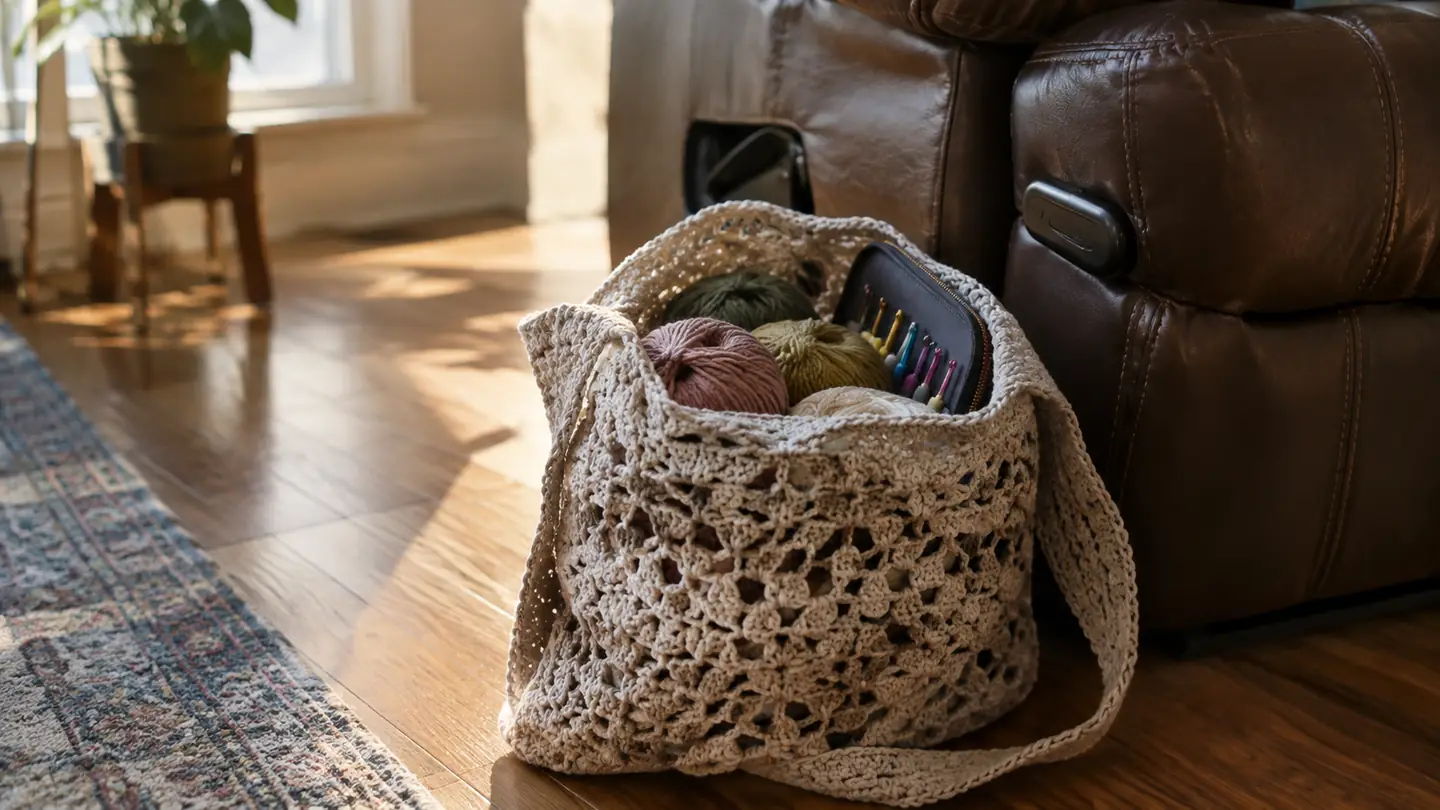
If you crochet anywhere except a dedicated craft room, you know the problem. The hook disappears into the couch cushion. The yarn ball rolls under the coffee table. The stitch markers scatter, and the small scissors you were sure you packed are suddenly nowhere. I have crocheted for about 30 years, and for most of that time my supplies lived in a plastic grocery bag that made everything worse. When I finally switched to a real crochet bag, the Leudes Crochet Bag Backpack, the way I work changed more than I expected. This is the exact system I use to keep hooks, yarn and notions organized in it.
I am Joanne, a retired middle school math teacher in Worcester, Massachusetts. I learned to crochet from my aunt when I was in my twenties, and these days I mostly make blankets, dishcloths, hats and baby gifts for my church's donation drive. I work in a recliner in my living room with a floor lamp beside me, and I block pieces at my kitchen table. That means my supplies travel from the living room to the kitchen and back again almost every day. A bag that keeps everything in its place matters more to me than it might to someone with a permanent craft table.
The bag that finally made my supplies stay put
After years of digging hooks out of couch cushions, I switched to the Leudes Crochet Bag Backpack. It has room for yarn, a dedicated hook case, and pockets that actually hold notions. See today's price on Amazon.
Amazon Check Today's Price on Amazon →Step 1: Sort everything into three groups before you pack
The biggest mistake I made for years was packing the way I thought, by project. I would toss in the blanket I was working on, the hook I was using, the yarn for that blanket, and then a few extra things just in case. The result was a bag where nothing had a home, and every time I opened it I had to hunt. Now I sort by category first: yarn, hooks, and notions. That single change made the Leudes bag easier to use than any bag I have owned.
Yarn goes in the main compartment. Hooks go in the hook case or the dedicated hook pockets. Notions, which means stitch markers, tapestry needles, scissors, measuring tape and row counters, go in the smaller pockets. When everything has a category, you can pack the bag in under two minutes and unpack it in under one. You also know immediately when something is missing, which is how I finally stopped losing my favorite hook.
If you are the kind of crocheter who carries three projects at once, sort each project into its own reusable bag or zippered pouch first, then put those pouches into the main compartment. The Leudes bag is large enough for that. I usually carry one project, but when I am making hats for the donation drive I will pack two or three hat projects in separate small pouches so I can grab whichever one matches my mood.
Step 2: Put the yarn in the main compartment with the working end on top
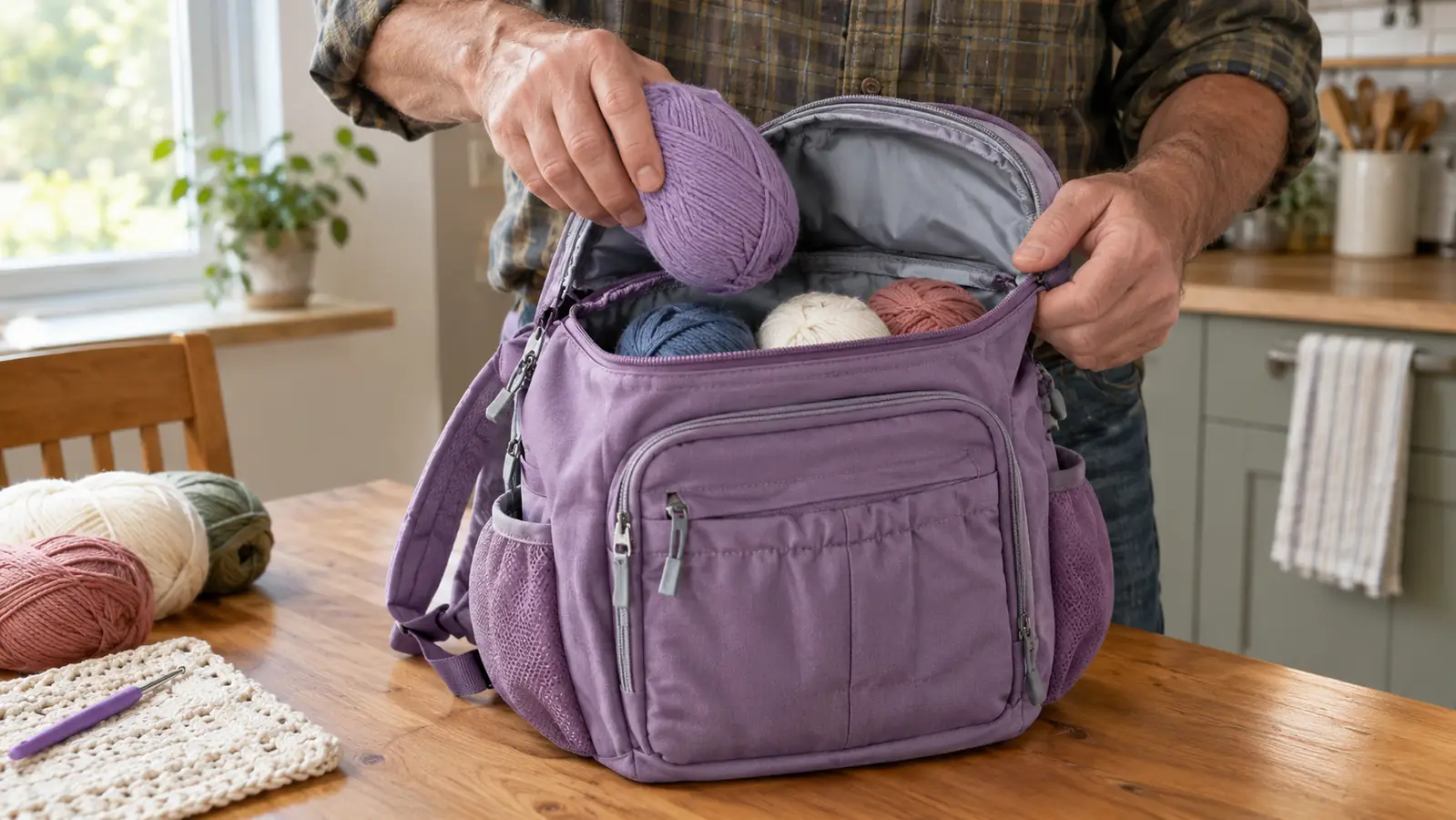
Yarn placement matters more than most people think. If you drop a skein into the bag any which way, the working end buries itself and you spend the first ten minutes of every session fishing for it. I put each skein in the main compartment with the working end facing up and toward the front of the bag. When I open the bag, I can see exactly which yarn I am using and grab the end without digging.
For balls that like to roll, I use the bag's structure to hold them in place. The Leudes bag has a roomy main compartment, and I tuck the yarn ball into a corner or against a pouch so it cannot travel. If I am working from the bag directly, I feed the yarn out through the top and let the bag sit beside my recliner. The yarn feeds smoothly and the ball stays inside, which means it is not rolling across the living room floor every few minutes.
One thing I learned the hard way: do not overstuff the main compartment. If you cram the bag full, the yarn compresses and the working end gets buried anyway. Leave a little room. The Leudes bag holds a surprising amount, but it works best when you can still see what is inside. I keep mine about three quarters full, and that is the difference between a bag I can pack quickly and a bag I have to unpack to find anything.
Step 3: Keep hooks in the dedicated hook case or hook pockets
Hooks are the easiest thing to lose and the most annoying to replace. I have a full set of hooks in a roll-up case, and I keep that case in the Leudes bag at all times. The bag has dedicated hook storage, which means I do not have to dig through yarn to find the hook I need. When I finish a project, the hook goes back into the case immediately. That one habit eliminated most of my lost-hook frustration.
If you only carry one or two hooks, the dedicated hook pockets work well. I tested that setup too, and it is fine for a small project. But I prefer the roll-up case because it keeps every hook visible. I can see at a glance whether I have the 5.5 mm hook I need for a blanket or the 3.5 mm hook for a baby hat. For me, seeing the whole set is worth the extra minute it takes to roll and unroll the case.
A note on grip: I have mild stiffness in my right thumb joint in cold weather, so I am picky about hook handles. The Leudes bag does not care which hooks you carry, which is exactly what I want. It holds ergonomic hooks with thicker handles just as easily as standard aluminum ones. If you use hooks with bulky grips, check that your hook case has wide enough slots before you commit to a case. The bag itself will not be the problem.
Step 4: Give every notion a pocket and put it back in the same pocket
Notions are small, cheap and endlessly frustrating to lose. Stitch markers, tapestry needles, a small pair of scissors, a measuring tape, a row counter. I used to keep all of these loose in the bottom of a bag, which meant I was constantly feeling around for a stitch marker that had slipped under a skein. Now every notion has a pocket, and every pocket has one job. The Leudes bag has enough pockets that this system works without any extra organizers.
My current setup: stitch markers live in a small zippered pouch in one pocket. Tapestry needles live in a short plastic tube in another pocket. Scissors and measuring tape share a pocket, with the scissors in a protective sleeve so they do not snag anything. A row counter clips to the inside of the bag. It sounds fussy, but it takes the same amount of time as throwing everything in loose, and I never have to hunt.
The rule that makes it work is simple: the notion goes back in its pocket when you are done with it, not when you are done with the project. If you wait until the project is finished, the stitch markers end up in the couch cushions. I speak from experience. Put it away while you are still sitting in the chair, and the bag stays organized for months instead of days.
Step 5: Use the outside pockets for the things you reach for constantly
The Leudes bag has outside pockets, and those are where the frequently used items go. For me, that means the hook I am currently using, the small scissors, and sometimes the pattern I am following. When I am working in my recliner, I keep the bag on the floor beside me, and I can reach the current hook without opening the main compartment. That sounds like a small thing, but it is the difference between pausing to dig and just continuing to crochet.
I also use an outside pocket for my phone, because I follow patterns on my phone sometimes and I like being able to grab it without unzipping the bag. If you carry a printed pattern, a clipboard or a small notebook, an outside pocket is the right home for it. The key is to reserve the outside pockets for things you use every session. If something goes in an outside pocket and you never touch it, it is taking space from something you actually need.
One caution: do not overload the outside pockets. The bag carries well when the weight is distributed, and a bulging outside pocket makes it awkward to carry. I keep the outside pockets to three or four small items. The heavy stuff, the yarn and the hook case, stays in the main compartment. That balance is what makes the Leudes bag comfortable to carry from the living room to the kitchen table and back.
What Else Helps
A good bag is only half the system. A few small organizers make the Leudes bag work even better. I use a roll-up hook case, which I mentioned in Step 3, and a set of small zippered pouches in different sizes. The pouches cost very little and they turn the big main compartment into a set of smaller, organized spaces. I also use a yarn bowl at home for active projects, but the bag is what keeps everything together when I move between rooms.
If you carry multiple projects, labeled pouches are worth the effort. A sticky label or a piece of masking tape with the project name on it means you can grab the right pouch without opening it. I label mine with the project type, like hats or baby blanket, and it saves me from unzipping three pouches to find the one I want. This is the same principle I used when I taught middle school math: everything has a place, and the place is labeled.
Another thing that helps is a small clip or carabiner on the outside of the bag for a tape measure or a small pair of folding scissors. That keeps those two items from taking up pocket space, and it means I can find them instantly. I have used this setup for months now, and the Leudes bag still looks and works the way it did the day I got it. The zippers are smooth, the straps are comfortable, and nothing has worn out.
The rule that made the biggest difference was simple: the notion goes back in its pocket when you are done with it, not when you are done with the project.
Set up your own Leudes bag in one evening
Sort your yarn, hooks and notions into the Leudes Crochet Bag Backpack and you will never dig through a grocery bag again. Check today's price on Amazon.
Amazon Check Today's Price on Amazon →